





24
Nov
Beyond Pesticides Calls on Governors To Restore Ecological Balance with Land Management Practices

(Beyond Pesticides, November 24, 2025) In his article on ecological traps, Professor Danilo Russo, PhD, explains the harm caused to wildlife from well-intentioned efforts to establish habitat on chemical-intensive farms or areas otherwise subject to chemical exposure. Dr. Russo et al., in “To improve or not to improve? The dilemma of “bat-friendly” farmland potentially becoming an ecological trap” (2024), write, “[W]hen restoring habitats for bats in conventional farmland, potential unintended outcomes must be considered, particularly if restoration actions are not accompanied by mitigation of key threats. These threats include the persistent and widespread use of pesticides. . .” (See also a study in Environmental Entomology, which shows that habitat and open space near agricultural fields become a killing field of pesticides, threatening biodiversity due to contamination from toxic drift.)
As this false sense of protection persists, Beyond Pesticides is calling on governors to adopt policies that support organic land management and ecological balance. Organic practices are, by definition, a systems change that is aligned with nature and the biodiversity protection that is needed.
Ecological traps are incremental steps that fail to address underlying systemic problems that allow hazards to persist. While they represent an affirmative action in an attempt to adopt restorative measures, the foundational pollution problem persists. Similarly, pesticide reduction strategies or mitigation measures adopted by the U.S. Environmental Protection Agency (EPA) to reduce exposure leave in place pesticide dependency that allows adverse effects to continue.
To mitigate the risks associated with chemical exposure from pesticides, the manufacturing and use of pesticides need addressing, first and foremost. This can be accomplished through adopting policies that support a biodiversity-centered worldview. Organic agriculture and land management have many health and environmental benefits, which eliminate the need for toxic pesticides. Regenerative organic agriculture revitalizes soil health through carbon sequestration while balancing natural communities.
To prevent well-intentioned efforts from becoming ecological traps, it is essential that measures supporting biodiversity be undertaken not as spot measures such as pollinator strips, hedgerows, or bat houses within areas dominated by chemical-intensive agriculture, but as part of a large-scale effort to adopt regenerative organic agriculture and land management supporting biodiversity.
With the weed killer paraquat in the news, it provides a powerful example of the consequences of an agricultural system dependent on toxic chemicals—demonstrating the need to rethink food production and the role of humans in the biosphere. While it is one of the most widely used herbicides in the U.S., paraquat has been characterized as “the most highly toxic herbicide to be marketed over the last 60 years.” By design, paraquat burns the foliage of any plant that it touches, by rupturing cellular membranes in plant tissue. In humans, it burns skin and eyes on contact and initiates lung damage (lung fibrosis) that is the most lethal and least treatable manifestation of toxicity, Ingesting as little as a teaspoon can cause organ damage or death. Chronic effects to those surviving exposure include Parkinson’s disease.
Paraquat’s damage starts before it is ever used. Like other pesticides, paraquat is manufactured from toxic precursors that pose threats to humans and the environment. And we’re learning that paraquat vaporizes more readily than previously thought, increasing exposure to workers, bystanders, and the environment.
Paraquat is only one of hundreds of chemicals that disrupt biological systems. A review article published in the International Journal on Environmental Sciences highlights how pervasive pesticide exposure and climate change threaten global species biodiversity. Now more than ever, people are changing their sentiment toward sustainability, with two-thirds of consumers stating the importance of limiting climate change impacts and 88 percent supporting greater pollution reduction.
Pesticide residues readily contaminate all ecosystems and are prevalent in soils, water (solid and liquid), and the surrounding air. Scientific literature demonstrates pesticides’ long history of adverse effects on the environment, including wildlife, biodiversity, and human health. The impacts of pesticides on wildlife biodiversity are extensive and expose animals in urban, suburban, and rural areas to unnecessary risks.
The broad impacts of paraquat on plants, which are intentional, are symptomatic of a worldview that sees the Earth merely as a resource for humans to exploit and disregards its value to others. This worldview accepts the use of biocides that eliminate all living things interfering with the production of human food. It does not value biodiversity or recognize that humans are a species that must share the Earth with others. On the other hand, organic agriculture, with its requirement to conserve (preserve and increase) biodiversity, is based on a worldview valuing long-term sustainability in which humans share Earth’s bounty. If humans are to persist on this planet, the balance of life must be supported.
Letter to Governor
Paraquat exemplifies the consequences of an agricultural system dependent on toxic chemicals—demonstrating the need to rethink food production and the role of humans in the biosphere. While it is one of the most widely used herbicides in the U.S., paraquat has been characterized as “the most highly toxic herbicide to be marketed over the last 60 years.” By design, paraquat burns the foliage of any plant that it touches, by rupturing cellular membranes in plant tissue. In humans, it burns skin and eyes on contact and initiates lung damage that is the most lethal and least treatable manifestation of toxicity. Ingesting as little as a teaspoon can cause organ damage or death. Chronic effects to those surviving exposure include Parkinson’s disease.
Paraquat’s damage starts before it is ever used. Like other pesticides, paraquat is manufactured from toxic precursors that pose threats to humans and the environment. And we’re learning that paraquat vaporizes more readily than previously thought, increasing exposure to workers, bystanders, and the environment.
A review article published in the International Journal on Environmental Sciences highlights how pervasive pesticide exposure and climate change threaten global species biodiversity. Now more than ever, people are changing their sentiment toward sustainability, with two-thirds of consumers stating the importance of limiting climate change impacts and 88 percent supporting greater pollution reduction.
Pesticide residues readily contaminate all ecosystems and are prevalent in soils, water (solid and liquid), and the surrounding air. Scientific literature demonstrates pesticides’ long history of adverse effects on the environment, including wildlife, biodiversity, and human health. The impacts of pesticides on wildlife biodiversity are extensive and expose animals in urban, suburban, and rural areas to unnecessary risks.
The broad impacts of paraquat on plants, which are intentional, are symptomatic of a worldview that sees the Earth merely as a resource for humans to exploit and disregards its value to others. This worldview accepts the use of biocides that eliminate all living things interfering with the production of human food. It does not value biodiversity or recognize that humans are a species that must share the Earth with others. On the other hand, organic agriculture, with its requirement to conserve (preserve and increase) biodiversity, is based on a worldview valuing long-term sustainability in which humans share Earth’s bounty. If humans are to persist on this planet, the balance of life must be supported.
To mitigate the risks associated with chemical exposure from pesticides, the manufacturing and use of pesticides need addressing, first and foremost. This can be accomplished through adopting policies that support a biodiversity-centered worldview. Organic agriculture and land management have many health and environmental benefits, which eliminate the need for toxic pesticides. Regenerative organic agriculture revitalizes soil health through carbon sequestration while balancing natural communities.
To prevent well-intentioned efforts from becoming ecological traps, it is essential that measures supporting biodiversity be undertaken not as spot measures such as pollinator strips, hedgerows, or bat houses within areas dominated by chemical-intensive agriculture, but as part of a large-scale effort to adopt regenerative organic agriculture and land management supporting biodiversity.
I urge you to take the lead in creating policies that move DC to organic agriculture and land management.
Thank you.
All unattributed positions and opinions in this piece are those of Beyond Pesticides.
Help support Beyond Pesticides’ mission of transitioning to a world free from toxic pesticides by becoming a member today. Learn more about the impacts of pesticides on health with the Pesticide-Induced Diseases Database and safer alternatives here and here.
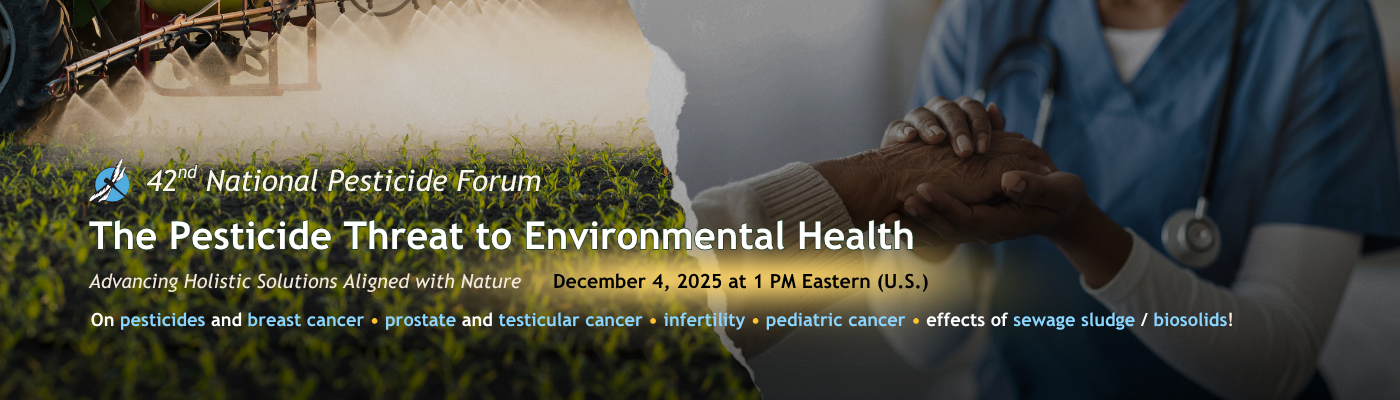
Join us for the SECOND session of the National Forum on December 4, 1 – 3:30 Eastern! Featuring Carolina Panis, Rossella Cannarella, M.D., PhD, Génon K. Jensen, Jabeen Taiba, PhD, and Emile Habimana, M.S., in a compelling discussion that elevates public understanding on the scientific data linking petrochemical pesticides to the crisis in breast cancer, prostate and testicular cancer, infertility, pediatric cancer, and sewage sludge (biosolids) fertilizer—supporting the imperative for ecological land management.





Dear Governor;
Any actions you can influence to preserve soil and health, will be applauded at least by those who understand. Also, actions to educate will mean our farming can be sustainable.
Thank you!
November 27th, 2025 at 9:45 am