





25
Nov
Report Links Prostate Cancer, Crashing Sperm Count to Pesticides; Medical Author To Speak at Dec. 4 Webinar

(Beyond Pesticides, November 25, 2025) Chemical pollution is having a profound impact on men’s overall health and reproductive function. Endocrine-disrupting chemicals—which prominently include pesticides—are a major factor. The Health and Environment Alliance (HEAL) a European organization funded by the European Union (EU) and several private foundations, has issued a strong call for attention to – and action on – the precipitous decline in male reproductive health owing to chemical exposures, including pesticides. In a new report, Chemical pollution and men’s health: A hidden crisis in Europe, the group states, “The scientific evidence is clear. The costs of chemical pollution – human and economic – are mounting. The solutions exist. What we need now is the political will to act.” The report was written by Rosaella Cannarella, M.D., PhD, an endocrinologist at the Division of Endocrinology, Metabolic Diseases and Nutrition, University of Catania (Italy).
HEAL’s report details alarming indications of catastrophe in male reproductive health: prostate cancer, testicular cancer, crashing sperm counts, and numerous developmental problems including cryptorchidism, urogenital malformations, and hypospadias. The report highlights pesticides, microplastics, phthalates, bisphenols, PFAS and heavy metals as the likely environmental sources of the crisis. There is evidence that all of these endocrine disrupting chemicals (EDCs) adversely affect male reproductive function.
There are 330,000 cases of prostate cancer in the EU. It is the third most-diagnosed cancer in men. Beyond Pesticides has documented research showing that pesticides have been linked to higher risk of prostate cancer, including, specifically, pyrethroid insecticides. See also Beyond Pesticides’ analysis of the positive association between exposure to 22 pesticides and prostate cancer occurrence and as a cause of death. In the EU, testicular cancer has jumped 25% since 2014, and is now the most common cancer in men 15 to 44, according to the HEAL report. Sperm counts declined by more than 50% between 1973 and 2018. Prostate cancer is the most common cancer in men in the U.S., with an estimated 34,780 new cases in 2025, one in eight men will get the disease, which has been increasing at a rate of 3.0% a year.
Chemical exposures to both parents can harm male offspring’s reproductive health. The HEAL report cites EU research that has found strong connections between maternal exposure during pregnancy to phthalates, BPA and pesticides and cryptorchidism, urogenital malformations, hypospadias and testicular cancer in their sons. Paternal exposure to EDCs, such as many pesticides, can have transgenerational effects. Both EDCs and microplastics can cause epigenetic changes in sperm and in genes crucial to development, thus potentially affecting ensuing generations’ reproductive health. These changes mean that the reproductive capacity of offspring can already be impaired even before conception has occurred.
The weed killer glyphosate is a prominent example of an endocrine disrupting pesticide. A recent study of glyphosate exposure in zebrafish by Italian researchers finds that at the acceptable daily intake level, glyphosate “impaired germ cell differentiation and triggered cell-specific changes in histone acetylation within the male germline.” Histone acetylation is an epigenetic process that regulates the activation and deactivation of genes, in this case those involving male reproductive structures and processes. At the higher “no observed adverse effect level,” glyphosate “induced metabolomic and proteomic disruptions linked to impaired steroidogenesis, DNA damage in germ cells, and alterations in testicular architecture, culminating in reduced reproductive capacity.” These differing effects at different doses suggest that glyphosate has a non-monotonic dose-response curve, contradicting the toxicological dogma that the “dose makes the poison.” Further, it suggests that these so-called protective exposure measures are nothing of the kind.
Microplastics are emerging as a potentially severe and intractable contributor to male reproductive dysfunction. A literature review of over 90 scientific articles in Agriculture documents microplastics’ (MPs) increase the bioavailability, persistence, and toxicity of pesticides used in agriculture. According to the HEAL report, studies in Europe, the U.S. and China have found microplastics in 100% of human testicular tissue sampled. They may interfere with sperm formation, disrupt testosterone production, and trigger inflammation in reproductive organs. Microplastics have been found in the olfactory bulb in the brain and there is evidence that they can also reach the brain across the blood-brain barrier.
Both pesticides and microplastics have profound effects on the brain, which is inextricably involved with reproductive development and function. The gut-brain axis is involved in testosterone synthesis and circulation, and microplastics may affect it through interactions with gut microbes. Glyphosate and organophosphates disrupt another important system, the hypothalamic-pituitary-gonadal axis (HPG) in animals, according to the HEAL report. Two of these three hormonal axis elements are in the brain. The HPG axis affects testosterone synthesis, the development of testes, and behavior after sexual maturation. There is also a great deal of interaction between microplastics and pesticides, as detailed in Beyond Pesticides’ March 22, 2024 news brief, illustrating the kinds of overlap that can occur among the chemicals the HEAL report considers. These interactions in the brain and throughout the endocrine system need further research.
The HEAL report also demonstrates the deleterious effects on male reproductive health of other environmental toxicants. Prenatal exposure to phthalates is associated with “reduced semen quality, DNA fragmentation, and lower testosterone levels,” the HEAL authors state. Similarly, the report cites research showing that some EU countries had detectable bisphenol A (BPA) in 100% of study participants, and many exceeded the EU’s acceptable daily intake. BPA is linked to reduced sperm concentration, altered motility and morphology along with altered testosterone levels. A biomonitoring study in the Flemish region of Belgium found PFAS in upwards of 95% of the population. PFAS exposure is associated with delayed puberty, poor sperm quality and low testosterone in young men. The heavy metals lead, cadmium and mercury are associated with sperm abnormalities including poor motility and morphology. Lead exposure altered sperm epigenetics in battery and recycling workers. Mercury is an endocrine disruptor and impairs fertility.
Thus, the HEAL report brings together the cumulative impact of all these chemical depredations on male reproductive health, demonstrating the simultaneous and interactive consequences of exposure to the suite of insults everyone is now trying to cope with.
The HEAL report also elucidates the varying costs of male reproductive disorders–direct medical costs, indirect costs of lost productivity and disability, and intangible costs of emotional distress and stigma. The direct costs alone are massive: Treating prostate cancer costs 9 billion Euros ($10.4 billion) annually; male infertility affects a twelfth of European couples and costs 3-4.5 billion Euros ($3.5-$5 billion) a year. A 2015 analysis cited in the report estimated the costs of EDC-related male reproductive health disorders at 15 billion Euros ($17 billion) annually, a figure that is surely much higher now.
“The mounting evidence linking chemical exposure to serious men’s health outcomes—infertility, cancer, hormonal disorders—demands an urgent policy response. While Europe has made important progress in identifying and regulating hazardous substances, human biomonitoring data and public health trends indicate that the current regulatory mechanisms remain insufficient to protect male reproductive health,” the HEAL report states. This position reflects HEAL’s intent to press the European Commission (EC) just as it prepares to adopt a revision of its landmark 2007 Registration, Evaluation, Authorisation and Restriction of Chemicals (REACH) legislation. The EC has stated an intent to release the revision by the end of the fourth quarter of 2025, but the revision has dropped from the Commission’s final agenda for the year and it appears its current text is not publicly available. According to wca-environment.com, a chemical industry consultancy, the revision will add increasingly stringent criteria for persistent, mobile and toxic chemicals along with an EDC assessment and a mixture assessment factor to the REACH chemical safety assessment. The new REACH will reportedly also introduce a definition of, and compliance guidelines for, nanomaterials.
HEAL is advocating for more focused health measures, including:
- Group-based chemical bans – restricting entire groups such as all bisphenols and all phthalates at once rather than piecemeal regulation of individual chemical group members.
- Mandatory mixture toxicity assessment to account for combined exposures.
- More human biomonitoring data collection.
- Regulation of microplastics, to address their toxicity and not just their size.
- Regulation of polymers and additives.
Unsurprisingly, the chemical industry has created significant undertow to the momentum of REACH revision. The EC is advised by a Regulatory Scrutiny Board (RSB) that reviews proposed legislation, provides impact assessments, and evaluates revisions to existing laws. In October the RSB issued a “negative opinion” on the impact of proposed REACH revisions. The actual RSB opinion text does not appear to be publicly available, so details are sketchy. According to Enviresearch, a chemical industry consultancy, the opinion says the EC needs to review information on critical hazard classes, uses and exposure and unaddressed risks from polymers. But it also notes concerns that new restrictions would slow the regulatory process, enforcement is inconsistent across member states, and imports, especially from online sales, do not comply with REACH requirements. These concerns reflect industry’s focus on economic values.
An analysis by the Society of Environmental Toxicology and Chemistry (SETAC) notes that “According to chemicals policy experts, the RSB’s negative opinion reflects concerns that the proposal lacks coherence with current political priorities….The changing regulatory environment has created tensions between protecting public health and environmental standards while addressing industry competitiveness concerns.” [Emphasis added.]
Against the counterproductive political priorities and industry economic motives, HEAL executive director Génon K. Jensen writes in the report’s preface, “This report is a call to action. For the health of men today and the generations to come, we cannot afford to wait.”
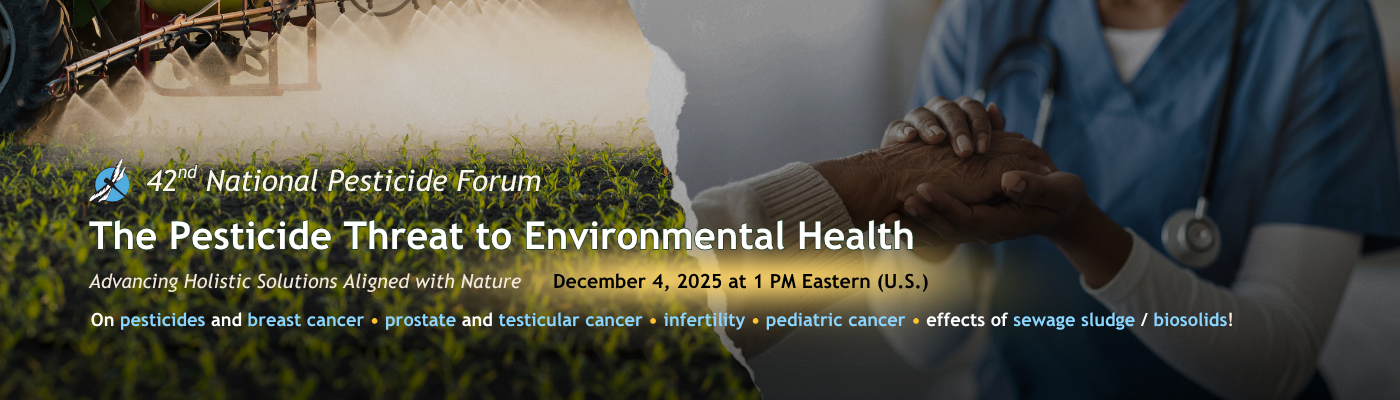
The author of Chemical pollution and men’s health: A hidden crisis in Europe, Rosaella Cannarella, M.D., PhD, and the founder and director of HEAL, Génon Jensen, will be speaking at the Forum, The Pesticide Threat to Environmental Health: Advancing Holistic Solutions Aligned with Nature, on December 4. Registration is free.
GET THE FACTS FROM CUTTING EDGE SCIENTISTS on pesticides and prostate cancer, breast cancer, pediatric cancer, and sewage sludge/biosolids! ️ Jay Feldman, executive director of Beyond Pesticides, moderating. Registration provides access to all sessions of the Forum!
We look forward to seeing you! Please share and help us spread the word! ️➡️ Link to register
All unattributed positions and opinions in this piece are those of Beyond Pesticides.
Sources:
Chemical pollution and men’s health: A hidden crisis in Europe
HEAL Health and Environment Alliance November 2025
https://www.env-health.org/wp-content/uploads/2025/11/2025_Chemical-Pollution-and-Mens-Health-Report.pdf
New report: Chemical pollution driving men’s health crisis
HEAL – Health and Environment Alliance
https://www.env-health.org/new-report-chemical-pollution-driving-mens-health-crisis/
Microplastics Interact with Pesticides, Exacerbating Environmental Health Threats, Studies Find
Beyond Pesticides, February 25, 2025
https://beyondpesticides.org/dailynewsblog/2025/02/interactions-between-microplastics-and-pesticides-exacerbate-their-environmental-health-threat-studies-find/
Plastics in Agriculture and Packaging Clog Arteries Raising Rate of Cardiovascular Disease and Stroke
Beyond Pesticides, March 22, 2024
https://beyondpesticides.org/dailynewsblog/2024/03/plastics-in-agriculture-and-packaging-clog-arteries-raising-rate-of-cardiovascular-disease-and-stroke/
Gut microbiota is involved in male reproductive function: a review
Lv et al
Frontiers in Microbiology 2024
https://pmc.ncbi.nlm.nih.gov/articles/PMC11099273/
Review: Mechanisms of Glyphosate and Glyphosate-Based Herbicides Action in Female and Male Fertility in Humans and Animal Models
Serra et al
Cells 2021
https://pubmed.ncbi.nlm.nih.gov/34831302/




