





07
Jan
Bayer/Monsanto Legislation to Stop Lawsuits for Failing to Disclose Product Hazards Stalls in House
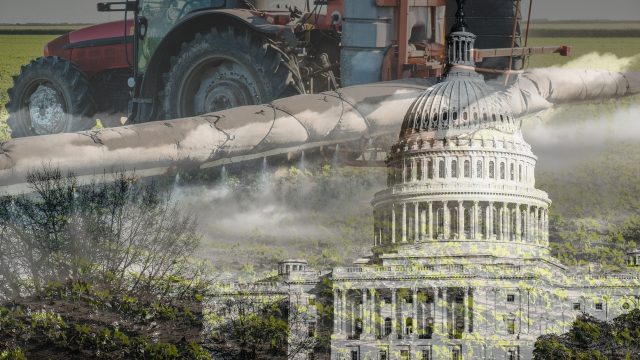
(Beyond Pesticides, January 7, 2026) Chemical manufacturers may have suffered a short-lived setback in their quest for statutory immunity from lawsuits due to their failure to warn those harmed by their products, but their campaign in Congress, state legislatures across the country, and the U.S. Supreme Court is continuing.
On Monday, January 6, it was announced that a provision denying people the right to sue chemical companies for nondisclosure of product hazards had been dropped from the FY2026 funding bill in the U.S. House of Representatives. This summer, a provision passed by the House Appropriations Committee would have denied farmers, farmworkers, landscapers, gardeners, and consumers generally the right to sue companies that do not disclose on their product labels and in marketing information potential hazards associated with their products’ use.
“With the announcement that appropriations legislation moving through Congress does not contain a provision that would shield chemical manufacturers from lawsuits for their failure to warn those harmed by their products, we stress that the industry’s campaign to escape accountability is proceeding with a fierce determination,” said Jay Feldman, executive director of Beyond Pesticides.
The chemical industry, spearheaded by the chemical giant Bayer/Monsanto, in the last year has waged an all-out, multi-pronged campaign in the courts, Congress, and state legislatures to quash lawsuits by those who have been harmed, but not warned, about hazards associated with pesticide products. Over the last several years, Bayer/Monsanto has been held to account for its failure to warn those harmed by their products, with over 10 billion dollars in jury verdicts and settlements in cases involving its weed killer RoundupTM (glyphosate). After the International Agency for Research on Cancer (IARC) determined that glyphosate is “probably carcinogenic to humans” (Group 2A) in 2015 (see Daily News here), the EPA maintained its position that the weed killer is not carcinogenic and in 2019, refused to approve a cancer label warning. (See Daily News here.)
U.S. Representative Chellie Pingree (D-Maine), Ranking Member of the House Appropriations Interior, Environment, and Related Agencies Subcommittee, who is leading the charge against the industry bill language, said, “For too long, powerful chemical companies like Bayer have spent billions lobbying Congress to override the voices of states, towns, and families who are simply trying to protect their health. Despite their relentless efforts and thanks to immense public pressure, we successfully stripped the industry-backed pesticides preemption rider, Section 453, from the final Interior and Environment funding bill.”
Here is the chemical industry strategy:
Push for a U.S. Supreme Court hearing.
In an amicus brief published on December 1, 2025, the Office of the Solicitor General (SG) and the White House are calling on the U.S. Supreme Court (in Durnell v. Monsanto) to grant certiorari on Bayer’s petition to shield chemical companies that fail to warn people about the potential hazards of their pesticide products. The SG argues that the pesticide product label is totally controlled by the federal government and that chemical manufacturers in compliance with the EPA pesticide registration process cannot be held to any other, presumably more stringent, standard. The Supreme Court is expected to decide on hearing the case next week.
Push for Congress to pass legislation to shield chemical companies from failure-to-warn lawsuits.
The previous appropriations bill language, which may be attached to other legislative vehicles like the Farm Bill, effectively provides total pesticide immunity from lawsuits that challenge chemical manufacturers who withhold information on the harm that their products can cause. Public health and environmental advocates say that chemical companies have successfully lobbied for a weak federal pesticide law and then try to hide behind the law when sued for damages or failure to warn, telling the courts that their products are in compliance with pesticide registration standards and therefore they are not liable for harm or nondisclosure. [The bill language is found here. Search on Section 453.]
Push for state legislation to prohibit lawsuits for failure to warn.
After years of large jury awards, preemptive settlements, and lost appeals in cases involving exposure to the weed killer glyphosate, in 2024 launched a campaign to stop the company’s financial hemorrhaging with a state-by-state strategy to stop litigation for nondisclosure of the hazards associated with their products. To accomplish this, Bayer founded the Modern Ag Alliance, along with agribusiness groups including state Farm Bureaus, to stop what they describe as “scientifically unsound lawsuits” on the weed killer glyphosate.
In late 2025, a broad coalition, including Beyond Pesticides and over fifty organizations, coalitions, businesses, and leaders, called on Congress not to include Section 453 language in any federal appropriations package for the upcoming fiscal year.
For more information, see Beyond Pesticides’ resource hub (currently being updated for the 2026 state legislative sessions). See also background on Congressional legislation and solicitor general amicus on Bayer/Monsanto’s efforts to get its case before the Supreme Court.
All unattributed positions and opinions in this piece are those of Beyond Pesticides.
Source: Beyond Pesticides Press Release





Please stop the use of pesticides in our country.
January 7th, 2026 at 4:18 pm