





15
Jan
Nature-Based, Ecological Land Management Serves as Nonchemical Approach to Pest Suppression
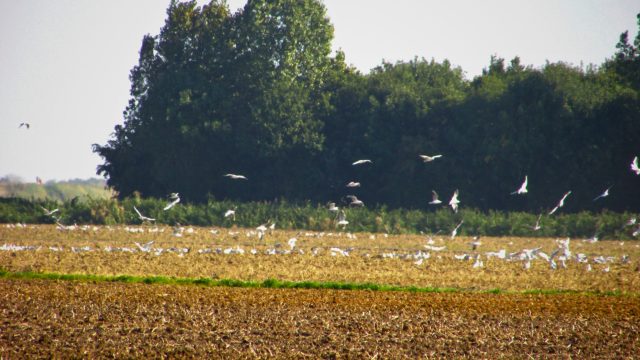
(Beyond Pesticides, January 15, 2026) “Birds and bats consumed over 87 rice pest species in West African lowland rice fields,” according to a recent study published in Agriculture, Ecosystems & Environment. The authors continue, “Our findings highlight the importance of maintaining and managing a diverse community of bats and birds for network resilience.” In this context, the research distinguishes the “predator-prey” as established through the ecological balance of diverse organisms in nature from a “predator-pest” orientation that views some organisms as unwanted and targets for control and more subject to human manipulation. The authors describe the predator-pest network as a means to quantify the “ecosystem services” impact, with the researchers noting that they “investigated the role of predator and prey species in the predator–prey network and compared those roles with that of the predator–pest network, to further explore their potential as pest suppressors.”
Communities across the United States and globally are looking for opportunities to transition to alternative pest management strategies given decades-long increasing reliance on synthetic pesticides and fertilizers, which contribute significantly to looming existential crises of biodiversity collapse, public health decline, and planetary instability of ecosystems, climate, and geopolitics. As evidenced in a recent report by Farm Action U.S. (2025), “Today, just four corporations—Bayer, Corteva, ChemChina, and BASF—control more than 50% of the global seed market, consolidating power with their patented genetically engineered seeds.” The privatization of agricultural tools of crop production that were once community-owned and moderated undermines thousands of years of community-led seed sharing and storage to prepare for harvest for the next season.
This same logic guides the approach to protecting and expanding the right of local municipalities to regulate pesticide and fertilizer use within their jurisdictions, treating federal pesticide law as a floor rather than a ceiling for public health and environmental protection.
Background and Methodology
There are three main objectives outlined by the study authors:
- “…Characterize and compare the dietary composition of birds and bats that feed on insects in West African rice fields, with a specific focus on potential rice pests in their diet;
- Analyse the structure of predator–prey and predator–pest networks to assess patterns of modularity, connectivity, and specialisation thereby addressing the gap in understanding functional complementarity among predators; and,
- Identify structurally important predator species within these networks and evaluate their potential contribution to pest suppression services and network stability under low-input, smallholder farming conditions.”
To better quantify the role of predator and prey species in their network compared to roles of the “predator-pest” network, species’ roles were assessed on several metrics, including species’ degree (“number of interaction partner species), strength (“the importance of each predator species for the set of prey species and vice versa”), and the specialization index (“quantifies the niche exclusiveness of a predator or prey, relative to a random distribution of interactions based on the observed interaction frequencies).
For additional information on the methodology, please see Sections 2.1 to 2.7.
The researchers collected fecal samples from 502 individual predators, including 345 bats and 157 birds. A total of 1,347 taxon, or Operational Taxonomic Units (OTUs) as referred to throughout the study as a means of organizing/listing their unique biological identity akin to the style of the Dewey Decimal Classification system, were found to interact with 34 predators (18 bats and 16 bird species). More specifically, “A total of 262 prey OTUs were classified to the genus or species level, of which 87 [were] classified as rice pests.” This research was conducted in northern Guinea-Bissau, in the “tropical sub-humid” region of Oio. The field work was carried out in rice fields in the towns of Farim and Mansaba and near six villages (Djalicunda, Bironqui, Lenquebato, Bereco, Demba Só, and Mambonco). The significance of this study is important for the local population as they are “heavily reliant on agriculture, with most people engaged in smallholder farming.”
Researchers for this study span several countries and specialties, including Centre for Ecology, Evolution and Environmental Changes, CHANGE – Global Change and Sustainability Institute (University of Lisboa, Portugal); Centro de Investigação em Biodiversidade e Recursos Genéticos, InBIO Laboratório Associado (Research Centre in Biodiversity and Genetic Resources, University of Porto, Portugal); BIOPOLIS Program in CIBIO (Portugal); Portuguese Society for the Study of Birds (Lisboa, Portugal); Organização para Defesa e Desenvolvimento das Zonas Húmidas (ODZH) (Organization for the Defense and Development of Wetlands, Guinea-Bissau); The Peasant Center of Djalicunda (Guinea-Bissau); Dipartimento di Scienze Agrarie, Alimentari e Forestali (SAAF) (Department of Agricultural, Food, and Forest Sciences, University of Palermo, Italy); School of Science, Engineering and Environment, University of Salford (United Kingdom); Department of Biology, Oxford University (United Kingdom); Instituto da Biodiversidade e das Áreas Protegidas (Institute of Biodiversity and Protected Areas, Guinea-Bissau); and Centre for Functional Ecology, Associate Laboratory TERRA, Department of Life Sciences, University of Coimbra (Portugal).
Funding for this study included research funding from the Foundation for Science and Technology (Ministry of Science, Technology, and Higher Education in Portugal) and the European Union’s Horizon 2020 research and innovation program. “The authors declare that they have no known competing financial interests or personal relationships that could have appeared to influence the work reported in this paper,” says the study. They continue in the Acknowledgments section: “The capture and handling of bats and birds, as well as the transport of [fecal] samples, were conducted under [license] from the Guinea-Bissau Nature Conservation Authority (IBAP – Instituto da Biodiversidade e das Áreas Protegidas).”
Results
Understanding the relationship networks between predator, prey, and pest is critical to the support for conservation efforts and broader pest management strategies without chemical dependency on the following grounds:
“Species occupying unique roles in arthropod consumption warrant close monitoring (e.g., bats C. pumilus, H. cafer/ruber and Scotoecus otu14 and birds P. melanocephalus, E. glaucurus and Ploceus otu33). Their roles in both networks suggest that, beyond delivering pest suppression services, they help maintain broader predator–prey dynamics. By regulating a wider range of prey, including taxa not yet recognized as rice pests, these predators can play a role in preventing future outbreaks.”
Some additional topline results from this analysis underscore the ecosystem services that birds and bat species can offer for agricultural and nonagricultural pest management:
- Overall, bats were found to interact with “significantly more OTUS” than bird species, signaling their slight edge in pest control relative to birds, although there is evidence in this study of both types of species with significant pest suppression potential.
- “The most frequently consumed rice pest species were the termites Macrotermes bellicosus (15 predators) andMicrotermes otu9 (11), and the spittlebug Poophilus costalis (9).”
- The top-ranking bird species in terms of predator-pest interactions included “the red-cheeked cordon-bleu Uraeginthus bengalus(N = 10; 39 %), the broad-billed roller Eurystomus glaucurus (N = 3; 30 %) and the African pygmy kingfisher Ispidina picta (N = 10; 25 %).”
- For bats, “the slit-faced bat Nycteris otu27 (N = 5; 35 %), and the vesper bats Neoromicia otu35 (N = 3; 29 %) and Scotophilus otu21 (N = 4; 22 %) showed the highest frequencies of pest interactions.”
The researchers point out that many farmers in this region of the country view birds as “major threats to rice fields.” While this is certainly true for certain species like weavers, in reality, “these same species may also provide important pest-suppression services.”
Previous Coverage
The impacts of pesticide use on bird populations cannot be understated. The latest State of the Birds 2025 report finds concerning news for bird species across the country. As the article says: “Whether they hop around the prairie, dabble in wetlands, flit through forests, or forage along the shore, birds are suffering rapid population declines across the United States… If these habitats are struggling to support bird species, it’s a sign that they’re not healthy for other wildlife, or even humans—but working to restore them will have benefits across ecosystems.” Additionally, a 2025 study in Science of The Total Environment shows pesticide residues in birds’ nests correlate with higher numbers of dead offspring and unhatched eggs. The data reveals higher insecticide levels are linked to increased offspring mortality and threaten biodiversity. Lastly, a study published by scientists in France from La Rochelle University’s Chizé Center for Biological Studies in 2024 finds lower pesticide load in chicks from a bird of prey species in areas with organic farming.
Bats, meanwhile, among other wildlife including birds and bees, provide important ecosystem services through pollination, management of pest populations, and contributing to plant resilience and productivity. The importance of bat species and their services cannot be understated. Bats are the only nocturnal insect predator in the U.S. and are one of two primary nocturnal pollinators (along with moths) — important roles for night-flowering plants and for farmers.
Seed dispersal is an important service bats provide. “Some seeds will not sprout unless they have passed through the digestive tracts of a bat. Bats spread millions of seeds every year from the ripe fruit they eat… Fruit bats are responsible for 98% of the reforestation of the world’s rainforests (the lungs of our planet). Without fruit bats, we would lose entire forests without felling a single tree,” Bat World Sanctuary notes. Bats’ ecosystem services—relatively invisible because they do their insect marauding at night when humans are not watching—represent an excellent nontoxic, biological control for some agricultural pests, as well as for mosquitoes that may be human disease vectors. This highlights the public health benefits from bats, as they lower health care costs by reducing toxic pesticide use on chemical farms and in their ability to lower the rate of mosquito-borne disease. Bats are also incredibly useful in the study of emerging viral diseases such as coronaviruses, and add an inherent, existential value to natural landscapes. See previous Daily News, Bat Conservation Enhances Ecosystems and Agricultural Productivity, Natural Alternative to Pesticides, for additional information on the nature-based solution of bat conservation as a form of nonchemical pest management.
Please see previous Daily News coverage on birds and bats for additional information and research. You can also view our dedicated resource pages for birds and the Benefits of Bats page for additional information synthesized for your own use and advocacy!
Call to Action
For an enlightening overview of extensive peer-reviewed research on the ecosystem services of bats, please see a talk by preeminent ecologist, author, and professor Danilo Russo, PhD, at the 42nd National Forum: The Pesticide Threat to Environmental Health—Advancing Holistic Solutions Aligned with Nature.
Continue to stay apprised of the most pressing developments on various issues and campaigns by signing up for Weekly News Update and Action of the Week—including a call to tell your U.S. Senators and U.S. Representative to hold oversight hearings to determine how EPA can eliminate the use of toxic pesticides that are no longer needed to grow food or manage landscapes cost-effectively.
All unattributed positions and opinions in this piece are those of Beyond Pesticides.




