





24
Dec
Holiday Wishes and Looking Toward Our Organic Future for the Common Good in the New Year

(Beyond Pesticides, December 24, 2025 – January 1, 2026) From the entire Beyond Pesticides team, we wish you happy holidays and a healthy new year in 2026! We hope this holiday season is filled with lots of organic gifts, organic food, and even organic Christmas trees for those who celebrate!
Despite the current realities, our program and the people and organizations we collaborate with embrace optimism about the future—solutions are within reach and community-based actions put us on a path to meaningful health and environmental protection. Simultaneously, we recognize the need to respond to the serious magnitude of the crises that too many people are facing.
We look forward to working with you in the new year to meet the severe environmental and public health challenges with organic solutions that eliminate continued use of petrochemical pesticides and fertilizers!

Click above to see our A Year in Review for 2025, and check out our newly-released 2024-2025 Annual Report and 2-page summary!
Our Mission
While the threats of health, biodiversity, and climate crises grow exponentially, the solutions we have advocated for decades are now within reach. We know how to produce food and manage land without petrochemical pesticides and fertilizers, as organic food is widely available. Beautiful parks, playing fields, and schoolyards do not require toxic chemical use. At the same time, the regulatory system underperforms, as existential health and environmental problems escalate. And, we know that individual steps that we take to stay healthy, as important as they are, cannot protect us and the natural world, on which life depend, from involuntary petrochemical exposure through ongoing contamination of land, air, and water. The science is telling us that we can no longer tinker with chemical reduction strategies that fall short of protecting our health, biodiversity, and climate.
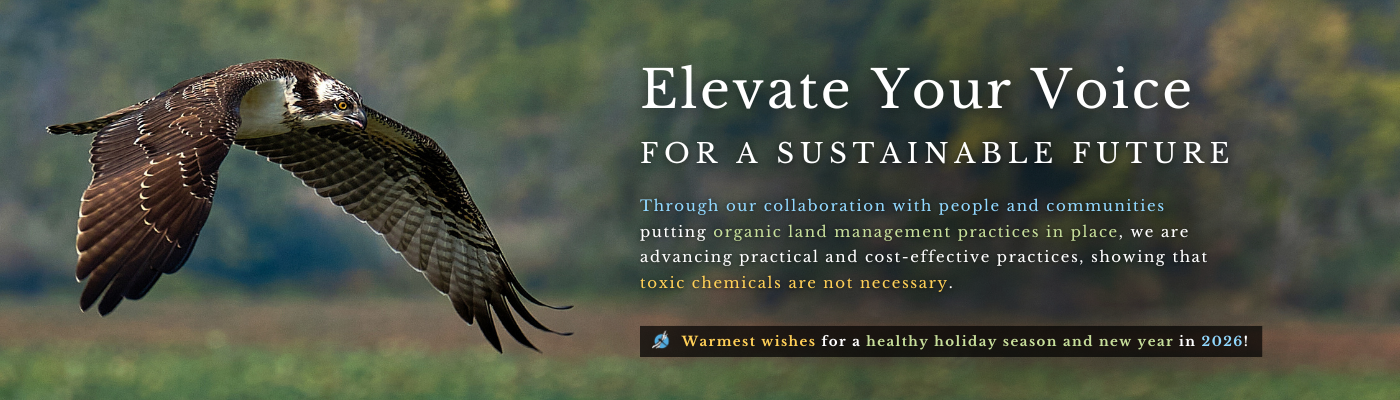
We are redoubling our efforts against what may seem to be insurmountable challenges, given chemical industry and agribusiness power and a presidential administration committed to deregulating and dismantling environmental programs intended to protect health and the environment. With your help, we advocate with a strong voice based on our daily tracking of scientific studies and our policy analysis. Our collaboration with people and communities puts organic land management practices in place, starting with a soil analysis, recommended practices and materials, and technical support. We are advancing practical and cost-effective practices, showing that toxic chemicals are not necessary for land and building management.
Our goal is clear: END the use of petrochemical pesticides and fertilizers, and utilize practices and products that are in sync with nature and compatible with organic standards. This goal can be achieved through the efforts described below, in which your support is essential.
Taking Bold Action
Our history is an important guide for our current program in this period of perilous catastrophic environmental and health threats, while effective and cost-saving solutions are within reach. Today’s health, biodiversity, and climate crises, associated with a confluence of factors including the reliance on toxic pesticides and fertilizer use, call for Beyond Pesticides’ bold program. Our strategy questions underlying norms of toxic chemical dependency, enabling broader public understanding of pesticide hazards in air, water, land, and food, while leveraging the opportunity for foundational change in product choices and the management of land and buildings.
Strategic Objectives
- Empower strategic local action with knowledge on: a. The current and looming threats to human health and ecosystems, and the dire consequences of inaction or measures that fall far short of what is necessary; and b. The path forward to eliminate the use of petrochemical-based pesticides and fertilizers, including the constellation of toxic materials used in food production and the management of landscapes, gardens, parks, playing fields, and schoolyards.
- Support, through hands-on practices and policies, the adoption of agroecological principles embodied in organic standards with the goal of supporting organisms in nature that are essential to a balanced natural environment, ecosystem services, and are essential to sustaining life.
- Tracking the science and regulation to support toxic pesticide elimination with our Daily News and extensive databases (Gateway on Pesticide Hazards and Safe Pest Management, the Pesticide-Induced Diseases Database, and ManageSafe) and in thwarting threats to health, biodiversity, and climate.
- Policy advocacy with our unique and targeted Action of the Week, providing easy personalization and submission of comments to policy makers at the local, state, and national level, supported with technical analysis on the hazards associated with current or proposed practices and policies, and evidence of cost-effective nonhazardous alternatives.
- Technical support for transitioning communities to organic land management to protect ecosystems and the organisms that inhabit them, including bees, birds, bats, and other organisms essential to a livable future, recognizing the importance of nurturing complex biological communities that support life.
- Networking for change through collaboration with local, state, and national groups, growing a powerful force for systemic and foundational change that recognizes both the harm to health and the ecosystem, as well as the availability of cost-effective, productive, and profitable alternatives not reliant on petrochemical pesticides and fertilizers.
- Protecting those with elevated risk factors who are disproportionately affected, encompassing a range of factors that include high-risk occupations (from landscapers, farmworkers, to farmers), living near toxic sites, vulnerabilities associated with age (children and older population), and preexisting medical conditions (increasing vulnerability to exposure).
- Holding corporations accountable for misleading and harmful practices, filing consumer protection cases that allege that targeted corporations engage in fraudulent and misleading practices with marketing and labeling claims that products are protective of the environment, “eco-sensitive,” and safe, when they contain hazardous chemicals.
- Protecting local authority and legal recourse by ensuring local and state governments’ authority to restrict pesticides, people’s ability to sue for failure to warn, and the integrity of organic standards under federal law.
Tracking the Science
Our daily objective at Beyond Pesticides is to inform action to empower advocacy with science, policy solutions, and practical implementation of cost-effective alternatives. Conventional, chemical-intensive land management practices are not sustainable. Petrochemical pesticide and fertilizer dependency contributes significantly to escalating crises in health, biodiversity, and climate. We talk about improvement in public health and environmental protection as requiring science, policy, and action.
We need all three of these pillars, with the central pillar—science—informing action and changes in practices and policy. In this context, we publish the Daily News and then catalogue the findings in our Pesticide-Induced Diseases Database on health and biodiversity effects, and What the Science Shows on Biodiversity—pollinators and other organisms—which provides the science that informs action. In each Daily News, we critique the study under review and then link to our databases and previous critiques to establish a pattern of harm and the preponderance of evidence that supports the urgent need for action.
Organic as a Social Good
Our strategy distinguishes Beyond Pesticides from campaigns against individual pesticides or pesticide families, which historically is an approach that leaves us confronting new chemical replacements and more complex problems. We no longer use the word “reduce” and, instead, define our efforts to “eliminate” toxic pesticide and fertilizer use. We are careful to shine a spotlight on flawed and outdated statutes and regulations that do not integrate into their standards the viability of organic practices as a social good to meet the urgency of the moment.
Transitioning to Organic in Communities
With a hands-on program called Parks for a Sustainable Future, we work to show the cost-effective viability of organic land management practices in communities across the U.S. that serve as models for the nation. While we help to elevate the demand for organic food and advocate to ensure the integrity of the underlying standards, we are effecting a wave of actions nationwide to show communities, through demonstration projects, the benefits of organic land management in parks and on playing fields and open-space. Our goal is to establish successful community-based programs as a springboard for the wide adoption of ecologically sound land management practices. We bring horticultural skills to communities to put in place organic management. We provide technical support to communities and continue a robust program of empowering local leadership with science and technical information for effective change.
Raising Voices for Change
During these times, Beyond Pesticides urges sending a message even to those who refuse to listen. As we strive to adopt the changes essential for a livable future, we believe that we must create a record that is based on science, even when the science and the facts are dismissed by those in power. To this end, the failure of action to address the existential health, biodiversity, and climate crises by those in Congress and the administration empowers lower levels of government and some corporations to step into the void left by those whose actions or inaction threaten life.
For even more details on our work in 2025, see A Year in Review for 2025, as well as the 2024-2025 Annual Report and 2-page summary!
 The Future
Our program empowers people to take action and effectively advocate with critical information and support. There is an urgency now requiring us to act holistically—not with piecemeal strategies, if we are to effectively tackle the existential threats to health, biodiversity, and climate that intensified with petrochemical pesticides and fertilizers.
The challenges ahead require that we redouble our efforts. Beyond Pesticides’ collaboration with people and communities in every state is providing the energy and enthusiasm to embrace the changes necessary to stop toxic pesticide use and embrace organic practices and policies. We know it can be done if we join together to protect health and the environment with science, policy, and activism. The solutions are within our reach.
It’s a fact. Your support makes our work possible. A special thank you to all our donors and supporters this year. Without your engagement and incredible generosity, it would not be possible to lead the transition to a world free of toxic pesticides. Our team at Beyond Pesticides looks forward to continuing to partner with you in the new year to meet the existential environmental and public health challenges with truly organic solutions through policy, science, and action—one day at a time for ourselves and for future generations!

Wishing a healthy and happy holiday season to all! The health and environmental challenges that we face as families and communities across the nation and worldwide require us to stay engaged. The stark reality of the challenges ahead energizes us at Beyond Pesticides to strengthen our program—now, more than ever!
See the enclosed holiday message from Jay Feldman, executive director of Beyond Pesticides.
All unattributed positions and opinions in this piece are those of Beyond Pesticides.




