


30
Jan
Bats and Their Roles in Insect Management, Pollination Benefit from Beavers’ Ecosystem Work, Study Finds
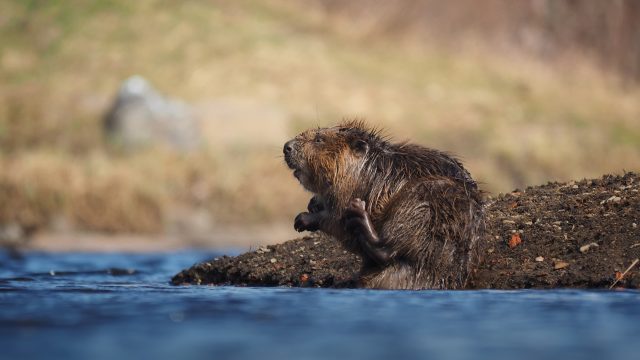
(Beyond Pesticides, January 30, 2026) In a 2025 study published by the British Ecological Society’s Animal Ecology, researchers’ findings “suggest that beaver engineering created structurally diverse habitats that supported a broader range of bat species.” It is well-established that bats perform important ecosystem services, which help to prevent and manage insect problems in balanced ecosystems. The researchers find: “By modifying both habitat structure and prey abundance, beaver engineering affected bat activity, richness, and feeding activity directly and indirectly. These changes operated across aquatic–terrestrial boundaries, highlighting the cross-ecosystem influence and ecological complexity of ecosystem engineering.”
Environmental and public health advocates have long called for nature-based solutions to pest management that provide critical support to at-risk wildlife (like beavers and bats) and reduce costs for agrichemical inputs to farmers due to improved ecosystem services (such as pest suppression and management). In turn, this holistic approach leads to secondary benefits like improved climate resilience and public health protection that are associated with the elimination of petrochemical pesticide use.
Background and Methodology
The researchers focused their study in eight stream ecosystems in differing contexts across Switzerland, choosing a diversity of habitats, including urban, agricultural, and forested zones. An area was selected with an active beaver pool, and a control area located 500 meters upstream or downstream with minimal or nonexistent beaver interactions. The researchers chose 500 meters as a short flight distance, writing, “Thus, if we observe a difference in bat richness, activity and feeding activity between Pool and Control, these changes can be attributed to modifications introduced by beavers rather than to broader landscape effects.” For more information on bat data collection, please see Sections 2.2.1, 2.2.2, and 2.2.3.
The primary objective of this study, according to the authors, was to “assess… the effects of beaver engineering on bat species richness, bat activity and bat feeding activity in eight stream ecosystems ranging from near-natural to heavily human-impacted, located across the Swiss midlands.” They studied bats directly and indirectly, via habitat modifications and adjusting the availability of food, respectively. In terms of data analysis, in Table 1 the authors identified 20 pathways/possible mechanisms determined in the prevailing scientific literature concerning beaver presence and bat abundance, ranging from statements such as “beaver engineering increases canopy heterogeneity” to “arthropod abundance is correlated to bat species richness.”
The researchers are based at various Swiss governmental and higher education institutions, including the Community Ecology and Biodiversity and Conservation Biology programs at Swiss Federal Institute for Forest, Snow and Landscape Research, Swiss Federal Institute of Aquatic Science and Technology, and National Beaver Specialist Centre (Nationale Biberfachstelle). The research was funded by the Blue-Green Biodiversity Research Initiative (through Swiss Federal Institutes of Technology Domain) and National Beaver Project. Regarding potential conflicts of interest, “The authors declare no competing interests.”
Results
Researchers in this study recorded 119,115 “bat sequences” through detectors that could capture the calls of passing bats over the course of 246 nights across the eight beaver-controlled areas (Pool) and control areas.
The authors confirmed their hypothesis, finding “that bat species richness, activity and feeding activity were significantly higher in beaver-engineered Pool compared to Control areas. Our models revealed that this higher bat richness, activity and feeding activity were related to direct beaver engineering effects on standing dead wood density and canopy heterogeneity, as well as indirect effects through arthropod abundance.”
For further information on the results, please see Section 3.2 of the study.
Previous Coverage
In the first session of the Beyond Pesticides 42nd National Forum, The Pesticide Threat to Environmental Health: Advancing Holistic Solutions Aligned with Nature (see here for recording), expert researchers convened to discuss their research and implications for the cost savings associated with ecological pest management, including Danilo Russo, PhD, professor of ecology at the University of Naples Federico II, international leader in bat research, and coauthor of A Natural History of Bat Foraging: Evolution, Physiology, Ecology, Behavior, and Conservation.
Dr. Russo has authored additional publications on the intersection of bat conservation and farmland protection in recent years that build on this sentiment. For example, a research study published in Agriculture, Ecosystems and Environment (2023) explores the concept of “bat-friendly” agricultural systems as an “ecological trap”—in other words, anthropogenic climate change can so fundamentally change the structure of ecosystems that wildlife (from bats to bears and everything in between) no longer can adequately “ assess habitat quality, luring them to poor habitats and reducing individual fitness.” This study examines European farmland and obstacles for habitat restoration for at-risk bat species on and bordering agricultural sites with “the persistent and widespread use of pesticides” noted as a primary threat to ongoing and future conservation efforts. Organic farming is referenced as a mitigation strategy/solution as opposed to bat conservation areas being established near pesticide use. The authors write, “Luring bats to agricultural sites highly contaminated with pesticides or where they may encounter ecological traps associated with infrastructures could have detrimental impacts on a broad scale.”
Pollinators and insects across the board have faced the repercussions of pesticide dependency. Pesticides can accumulate in aquatic fly larvae, be retained through metamorphosis, and represent a source of chronic pesticide exposure to birds and bats, according to research published in Environmental Science and Technology in 2022. It was determined that roughly 10.4−94.0 ng/m2 of pesticide per year is moving from aquatic to terrestrial ecosystems as a result of this process. This is a significantly higher amount than other studies, excluding these data, have estimated for the transition from waterbodies to land, which generally indicate a range of 0.4 to 26.8 ng/m². Ultimately, the researchers find that bats and birds feeding on contaminated midges could result in low to moderate chronic pesticide exposure. (See Daily News here.)
Please see previous Daily News, Bat Conservation Enhances Ecosystems and Agricultural Productivity, Natural Alternative to Pesticides, for additional details.
Tony Able, chair of the Southeast Beaver Alliance (SEBA) while serving on the Board of Directors for the Southeastern Trust for Parks and Land and speaker at the Forum, presented on the restorative benefits. Retired in 2022 after 35 years of distinguished service with the U.S. Environmental Protection Agency (EPA), his specialty is natural stream and wetland restoration, having contributed to a wide range of environmental issues, including watershed management, groundwater remediation, hazardous waste cleanup, nonpoint source pollution, wetlands protection, and water quality management.
“Doing stream and wetland restoration [at EPA], I came across this idea that beavers can be very strong partners in helping with restoration,” says Mr. Able. He continues: “I started the Southeast Beaver Alliance in 2024, partly because I wanted to stay engaged in science.”
On the subject of ecosystem services of beavers, Mr. Able highlights that there are only roughly 10-15 million beavers in the present day with estimates of 100-400 million beavers before the fur trade during colonial period of the 16th century onward. In a peer-reviewed paper (to be published in the near future) from a researcher based at SEBA, they identified in the literature 21 types of ecosystem services that beavers provide at local regional and global scales. The authors, SEBA affiliated Colin Van Buren, PhD and Emily Fairfax, Ph.D (University of Minnesota), reference benefits including the construction of aquatic habitats for other wildlife, filter pesticides and nutrient run-off from farms resulting from rural stormwater surges through beaver ponds, filter urban stormwater, support flood attenuation, wildfire control (providing safe havens for wildlife and emergency professionals alike), drought management, recharging groundwater offers, and re-greening grasslands.
“A number of farmers and ranchers are recognizing that holding that water on the landscape will re-green their farms and pastures,” says Mr. Able in his Forum presentation [begins at 1:25:52 timestamp].
Call to Action
You can learn more about the numerous Benefits of Bats on our dedicated webpage. Armed with this knowledge, you can sign up here to become a Parks for a Sustainable Future Advocate and sign up here to receive our Weekly News Update and Action of the Week every Wednesday and Sunday, respectively.
Missed the live seminar for the 42nd National Pesticide Forum? We are pleased to share—as a teaching tool—TWO recordings that capture the incredible knowledge and work of our incredible speakers who are helping to chart a course for a livable future with scientific research and hands-on work in the field. [SESSION 1| SESSION 2]
Sign up for Action of the Week and Weekly News Update to stay notified on ways you can take action to expand public investments in programs that expand organic land management, in agricultural contexts and on public green spaces, parks, and playing fields, to move beyond a reliance on synthetic materials. See ManageSafeTM for addressing pest prevention and management for land and buildings.
All unattributed positions and opinions in this piece are those of Beyond Pesticides.
Source: Animal Ecology