02
Jan
Bat Conservation Is Good for the Environment and Agricultural Productivity, A Natural Alternative to Pesticides
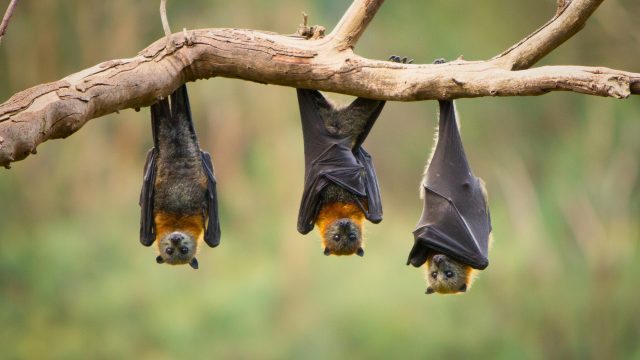
(Beyond Pesticides, January 2, 2026) Texas-based pecan orchard Swift River Pecans is collaborating with local conservation nonprofit Merlin Tuttle’s Bat Conservation “so they could collect more information on the species that visit his 266-acre property, and to show off the bats’ value to his operation,” according to recent coverage by NPR affiliate KCUR.
“Bats love to munch on insects like stink bugs and moths. Some farmers are now relying on the mammals for pest control – and ditching chemicals,” says Michael Marks, reporter for NPR (Harvest Public Media) and Texas Standard.
The orchard operator and nonprofit have been collaborating since 2004, after Troy Swift (orchard owner) employed a chemical-intensive approach since purchasing the land in 1988. Merlin Tuttle, “an ecologist and conservationist who has spent 65 years studying bats around the globe,” has been setting up bat boxes using cypress trees from a lumber mill on-site—the researcher has opted for this wood type because it is porous and regulates temperature appropriately.
“Our job is to work with Mother Nature instead of against her to make the best pecans money can buy. That’s the way we see it,” says Mr. Swift, who also serves as the president of the Texas Pecan Growers Association.
The orchard owner reflects on foregoing pesticide use entirely on a part of the orchard for the first time in its history: “This year is the first year I did not spray any insecticide at all…And guess what? We got a really good crop over there.”
This story is an example of a symbiotic relationship between farmers and conservationists, exemplifying the importance of ecosystem-based organic principles for pest management, with public health and environmental advocates continuing to call for a massive transition to organic-compatible pest management.
Forum Reflections from Bat Expert Dr. Danilo Russo
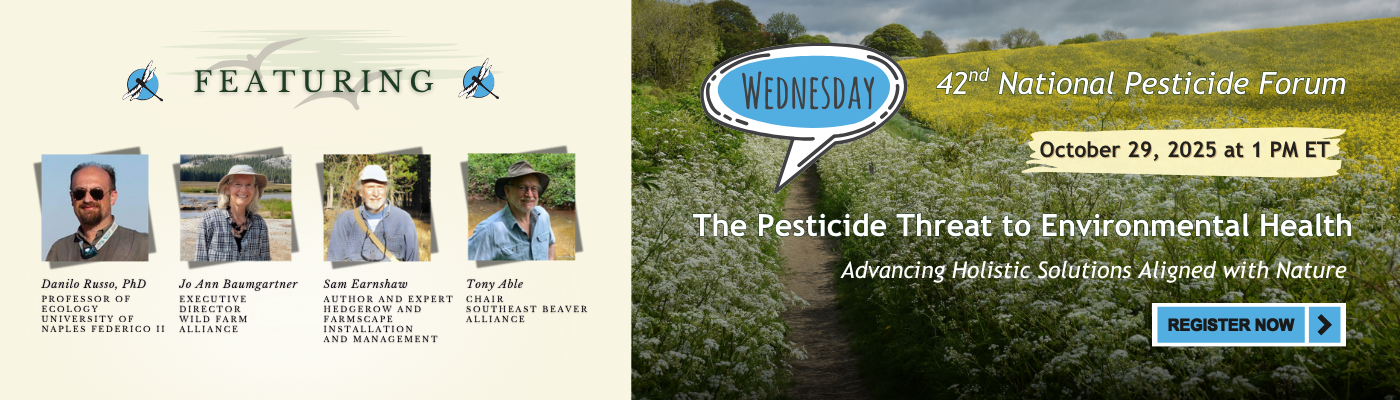
In the first session of the Beyond Pesticides 42nd National Forum, The Pesticide Threat to Environmental Health: Advancing Holistic Solutions Aligned with Nature (see here for recording), expert researchers convened to discuss their research and implications for the cost savings associated with ecological pest management, including Danilo Russo, PhD, professor of ecology at the University of Naples Federico II, international leader in bat research, and coauthor of A Natural History of Bat Foraging: Evolution, Physiology, Ecology, Behavior, and Conservation.
In a recently published commentary published in Conservation Letters (a journal of the Society of Conservation Biology), he writes the following:
“The ongoing biodiversity crisis highlights the need for targeted conservation efforts, yet the focus often remains on rare and endangered species. This overlooks the vital role of common species, which are the ecological backbone of ecosystems, supporting the stability and functioning of biodiversity.
We argue that common species, especially their population dynamics and potential tipping points, are too often neglected and that their conservation is urgent. We illustrate this issue using bats (Chiroptera) as a model. This diverse mammalian order features key ecosystem service providers, including insectivores, pollinators, and seed dispersers. Bats are sensitive to anthropogenic pressures, and many species, including common ones, face population declines and the impact of ecosystem disruption. Research and conservation must urgently be expanded to include common species.
Through case studies, we demonstrate how common bat species are indicators of environmental changes and the urgent need to monitor their populations. We provide recommendations for improving research, enhancing conservation policies, and adopting a more inclusive framework acknowledging the indispensable role of common species in ecosystem services and biodiversity.”
Dr. Russo has authored additional publications on the intersection of bat conservation and farmland protection in recent years that build on this sentiment. For example, a research study published in Agriculture, Ecosystems and Environment (2023) explores the concept of “bat-friendly” agricultural systems as an “ecological trap”—in other words, anthropogenic climate change can so fundamentally change the structure of ecosystems that wildlife (from bats to bears and everything in between) no longer can adequately “ assess habitat quality, luring them to poor habitats and reducing individual fitness.” This study examines European farmland and obstacles for habitat restoration for at-risk bat species on and bordering said farmland, with “the persistent and widespread use of pesticides” noted as a primary threat to ongoing and future conservation efforts. Organic farming is referenced as a mitigation strategy/solution to long-term conservation efforts.
In his presentation, Dr. Russo shares the benefits of bats as a natural form of pest management for farmland and ecosystem stability more broadly, citing peer-reviewed research, including research he has led or contributed to in multiple respects, which includes evidence of livestock pest suppression and pest management in Mediterranean rice paddies. (See peer-reviewed studies published in Agriculture, Ecosystems & Environment (2017) and Mammalian Biology (2015), respectively.)
Dr. Russo points to a “groundbreaking” U.S.-based study from 2011, published in Science, which calculates the estimated economic benefit of national bat conservation to be approximately $22.9 billion per year in terms of ecosystem services provided. While he characterizes this as a “gross simplification” in his presentation, Dr. Russo also notes that the cost-savings would still be “huge if halved or quartered.”
“Increasing bat diversity in bat communities or protecting bat biodiversity is also very important,” says Dr. Russo. He continues: “What we found in [a recent study based in Portugal] for the processionary [moving in a procession] moth is that higher bat diversity and abundance, the lower the number of pine processionary moths recorded in their foraging areas, which tells you that we should protect rich bat communities if we want to magnify the pest control effect exerted by bats.”
Previous Coverage
A previous Daily News, Climate Change Threat to Ecosystem Management of Insects Focus of New Book, cites a chapter written by Dr. Russo on the climate change impacts on the relationship between climate change, bats, and ecological balance in the book Biological Control Systems and Climate Change. As Dr. Russo points out, “Climate change can disrupt predator–prey interactions in agricultural systems by altering species’ physiology, distribution and behaviour,” including deleterious impacts on bat populations. Changes to temperatures and precipitation can destabilize the dynamics of existing resources, which can “reduce natural pest control effectiveness, increasing reliance on chemical methods.” Research, outlined below, shows that climate change impacts bat distribution, reproduction, behavior, and survival through heat stress and drought, among other factors.
Pollinators and insects across the board have faced the repercussions of pesticide dependency. Pesticides can accumulate in aquatic fly larvae, be retained through metamorphosis, and represent a source of chronic pesticide exposure to birds and bats, according to research published in Environmental Science and Technology in 2022. The researchers used formulated products that contained nine active ingredients, including the fungicides: azoxystrobin, boscalid, cyflufenamid, fluopyram, tebuconazole, pyrimethanil, trifloxystrobin, and the herbicides napropamide and propyzamide. It was determined that roughly 10.4−94.0 ng/m2 of pesticide per year is moving from aquatic to terrestrial ecosystems as a result of this process. This is a significantly higher amount than other studies, excluding these data, have estimated for the transition from waterbodies to land, which generally indicate a range of 0.4 to 26.8 ng/m². Ultimately, the researchers find that bats and birds feeding on contaminated midges could result in low to moderate chronic pesticide exposure. (See Daily News here.)
The health of bat species and organic agriculture is a symbiotic relationship. In a 2021 study published in Frontiers in Ecology and Evolution, it was found that bats foraging in chemical-intensive banana plantations have much less gut diversity than bats foraging in organic banana fields and natural forestland. Gut diversity in organic bats was found to be similar to the diversity analyzed in forest bats. The study indicates that it is likely that organic practices are maintaining a “high diversity of commensal microbiota,” while on the other hand, “less diverse gut microbiota in bats foraging in conventional monocultures may suggest that these habitats potentially have negative physiological consequences for the animals (e.g., gut inflammation and metabolic disease), and may act as [an] ecological trap.” (See Daily News here.)
In a more recent study published in 2025 in Global Ecology and Conservation, a survey of bat species in organic desert date palm plantations highlights the invaluable ecosystem services these beneficial organisms provide. “Bats are crucial in suppressing pest arthropods in agroecosystems, contributing vitally to sustainable agriculture,” the study authors share, which makes supporting bat populations important not just for biodiversity but to help enhance their roles in pest management. (See Daily News here.)
Bats are also facing the decades-long plight of white-nosed syndrome (WNS), with previous research demonstrating the decline of bat populations in the USA resulting from the spread of this lethal fungal disease caused by Pseudogymnoascus destructans. This mortality, due to the loss of ecosystem services that bats provide as natural predators, leads to dramatic increases in pesticide use. WNS has caused high mortality in bats, with rates averaging above 70%. This syndrome causes premature awakening from hibernation, which leaves bats with scarce food and low temperatures that threaten their survival over the winter.
A 2024 study finds that as a result of these implications, a corresponding rise in human infant mortality also occurs. Eyal Frank, PhD, an assistant professor of the Harris School of Public Policy at the University of Chicago, links increased insecticide use in croplands in the absence of bat species to a rise in infant mortality. As Dr. Frank says in the study, “[B]ats do add value to society in their role as natural pesticides, and this study shows that their decline can be harmful to humans.” He continues, “As of 2024, 12 of the roughly 50 insectivorous bat species in the US are negatively affected by WNS.” This study calls attention to the observable and statistically significant increases in insecticide use in counties that document WNS compared to non-WNS counties, with increased infant mortality also occurring in those areas. (See Daily News here.)
The ecosystem services that bats provide are invaluable to farmers’ financial security, as documented in peer-reviewed literature. For example, a 2020 study published in Molecular Ecology concluded that a certain species (Pipistrellus kuhlii) exploits pink bollworm irruptions – a menacing pest that threatens cotton production—by opportunistic feeding. (See Daily News here.) It is important to note that researchers found in a 2022 study published in the Journal of the Association of Environmental and Resource Economists that bat population declines are costing American farmers as much as $495 million each year. (See Daily News here.)
Call to Action
Environmental and public health advocates agree with researchers and farmers that investing in holistic conservation efforts not only provides economic benefits through ecosystem services but is also essential to addressing the existential threat of biodiversity loss amidst our chemical-intensive, fossil-fuel-based society.
You can learn more about the numerous Benefits of Bats on our dedicated webpage. Armed with this knowledge, you can sign up here to become a Parks for a Sustainable Future Advocate and sign up here to receive our Weekly News Update and Action of the Week every Wednesday and Sunday, respectively.
Missed the live seminar for the 42nd National Pesticide Forum? We are pleased to share—as a teaching tool—TWO recordings that capture the incredible knowledge and work of our incredible speakers who are helping to chart a course for a livable future with scientific research and hands-on work in the field. [SESSION 1|SESSION 2]
In the first session on October 29, 2025, the speakers provide a framework for applying a recognition of the value and importance of natural systems, with specific examples associated with the critical roles that bats, birds, and beavers play in effective agricultural and land management—including the use of hedgerows and other habitat-sensitive practices. The inspiring presentations and discussion helps us to rethink our approach to land stewardship, moving away from harmful practices to holistic solutions that support life-nurturing ecosystems and biodiversity.
All unattributed positions and opinions in this piece are those of Beyond Pesticides.
Source: KCUR ; Conservation Letters ; Agriculture, Ecosystems and Environment (2023) ; Agriculture, Ecosystems & Environment (2017) ; Mammalian Biology ; Science ; Science of The Total Environment