


18
Mar
Study Highlights Benefits of Organic Agriculture for Pollinator Health, Building on Existing Research
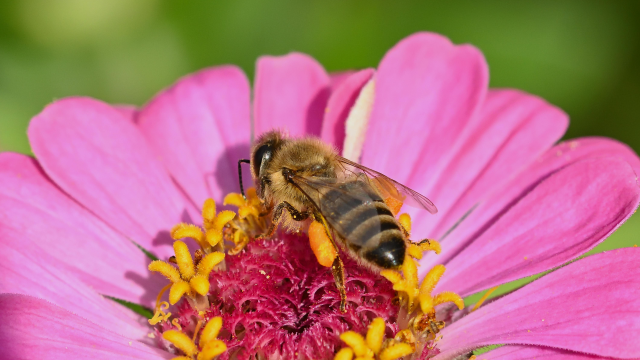
(Beyond Pesticides, March 18, 2026) Researchers in Germany and Brazil investigated the biodiversity of agricultural landscapes in organic and non-organic areas in “bee hotels,” finding that there is a positive correlation between organically managed fields and numerous indicators of improved pollinator health, including an “increase in bee abundance, species richness, and diversity.” This study, published in Global Ecology and Conservation, builds on the breadth of existing research in recent years that underscores the adverse public health and biodiversity effects associated with a food system that is drenched in synthetic chemicals, as well as additional evidence of the ecological and economic benefits of organic agriculture.
Methodology and Results
Research for this study “was conducted at 17 sites in the southern part of Germany, Baden-Württemberg, including eight conventional and nine organic farming systems.” Researchers for this study are based at the Institute of Evolutionary Ecology and Conservation Genomics at Ulm University in Germany and the Laboratory for Bee Studies at the Federal University of Maranhão in São Luís, Maranhão in Brazil. The authors signed a “declaration of competing interest,” stipulating that “that they have no known competing financial interests or personal relationships that could have appeared to influence the work reported in this paper.”
From the end of April to November 2021, cavity nests were installed and monitored until February 2022, giving the nests time to overwinter. The bees that spawned once were assessed for species type and sex after they were moved into a greenhouse and subsequently frozen for analysis.” To analyze differing landscapes across eight conventional and nine organic nesting sites, the researchers identified ‘foraging zones’ around each site based on units of circular areas within a 500-meter radius.
“Our study demonstrates positive effects of organic farming for solitary bees of the genera Heriades, Chelostoma, Hylaeus, Megachile, Osmia, Hoplites, and Coelioxys. Both brood cells and species abundance increased with a higher proportion of organic farming in the conventional agricultural landscape,” says the authors. They continue: “Similarly, bee diversity showed a significant positive response, while forest cover had no detectable effect. Difference on diversity cannot be attributed to proportion of bees that failed to develop. Regarding sexes, a higher abundance of both sexes, females and males was recorded within organic sites, at local and landscape levels.”
In discussing their main results, the authors explain: “The higher diversity of crop rotations and presence of semi-natural habitats and absence of heavy application of pesticides in organic systems likely provides critical resources that are often scarce in intensive conventional landscapes dominated by monocultures.” Their analysis confirms that landscapes with a significant presence of organic farms and organic-compatible pest management systems positively impacted pollinator abundance and diversity at the agricultural landscape and individual farm level.
The authors’ main takeaway is that organic land management principles, both on-farm and on the broader ecosystems in which they are embedded, play “a more critical role in supporting bee diversity and abundance as suggested previously.”
Previous Coverage
The issue of pesticide contamination in food production and in ecosystems continues to emerge with increased demand for residue testing. A new analysis by Environmental Working Group finds that “37% of non-organic, or conventionally grown, California produce samples had residues of pesticides that are ‘forever chemicals’ known as PFAS.” Beyond Pesticides has submitted comments on the five PFAS pesticides proposed for registration in 2025 (Cyclobutrifluram, Diflufenican, Isocycloseram, Trifludimoxazin, and Epyrifenacil), as well as the “emergency” exemption proposal for tetflupyrolimet on the basis of herbicide resistance, continuing to lock producers into toxic systems of degradation rather than non-chemical alternatives to pest management.
In terms of pesticide impacts on pollinators, a study published last year in Science of The Total Environment reports widespread pesticide contamination collected from beehive monitoring across the European Union (EU). “This study has produced the first EU-wide distribution map of terrestrial pesticide contamination and demonstrates widespread pesticide contamination of EU environments,” the authors write. The study, led by a cohort of citizen-scientists, documents pesticide drift across the European continent. The results found that 188 of the 429 targeted pesticide compounds were detected in noninvasive, in-hive passive samplers (APIStrips) across 27 EU countries between May and August of 2023. (See Daily News here.)
There is a significant record of the ecological and pollinator benefits of organically managed systems. In a 2024 study published in Journal of Applied Ecology, German researchers compared 16 agricultural landscapes in Lower Saxony and northern Hesse that have different combinations of semi-natural habitat, organic practices, and annual and perennial flower strips. Overall, the researchers found that organic farming provides the highest benefit to the bees, along with the presence of diverse flowering plants in and near monoculture fields. This study compares the effects of three honey bee conservation methods on the prevalence of the parasitic mite Varroa destructor and the 11 parasites Varroa transfers to bees, and the impact of these destructive organisms on bee colony growth. Organic practices lead directly to lower parasite load and higher colony growth—essentially, the more organic crops, the more bees, and the more parasites, the fewer bees. Pesticide use in monocultures doubles the damage. Pesticides increase mortality, damage bees’ immune systems, and reduce foraging capacity, while monocultures disturb bees’ nutritional balance, making them less able to resist parasites and survive pesticide exposure. (See Daily News here.)
In 2025, a study published in Conservation Genetics focuses on meadows in southern Bavaria (the largest state of Germany by surface land mass area). The study finds that biomass is significantly higher on organic meadows compared to the conventionally farmed ones. “The organically managed meadows returns 11.2% more BINs (5,679) than the conventionally managed ones (5,109), a highly significant difference,” the researchers conclude. They continue: “1,400 BINs (i.e., 22% of all BINs) were only found on the organic meadows… For most families, the comparison of organic and conventional meadows revealed a higher diversity in the organic meadows, irrespective of family size. Particularly rich on organic meadows were the Hymenoptera families Megachilidae, Cynipidae, Diapriidae, the Coleoptera families Buprestidae, Carabidae, and Mordellidae, as well as Thripidae.” (See Daily News here.)
Organically managed farmland has been found to have significant benefits for climate and the environment, according to USDA researchers and field trials run by Rodale Institute and higher education institutions around the U.S. and the globe. As one recent example, a study published in Scientific Reports highlights the benefits of organic agriculture in comparison to different farming systems over five years on four crops (maize, tomato, faba bean, and potato). “Soil carbon sequestration is a long-time storage of carbon in soil which represents 70% of the carbon in land,” the authors note. “Therefore, the main aim of this study is to investigate the effect of the agricultural practice systems on the soil carbon sequestration and properties, productivity, water consumption, soil carbon sequestration, CO2 emission and cost of some agricultural crops.” As a result, the experiment reveals that, compared to chemical-intensive farming, organic methods enhance soil properties, reduce water consumption, provide higher yields and higher soil carbon sequestration, reduce CO2 emissions, and achieve the highest total net profit for all four crops after five years. (See Daily News here.)
In the Journal of Environmental Quality, researchers at the U.S. Department of Agriculture (USDA) report that a 4-year organically managed corn-soybean-oat system reduces nitrogen (N) loads by 50 percent with corn and soybean yields “equivalent to or higher than conventional [chemical-intensive] in most years.” The findings from a 7-year study comparing nitrate loss in organic and chemical-intensive management found that organically managed perennial pasture reduced nitrogen loads significantly. The study, which focused on nitrate pollution in agriculture that harms biodiversity, threatens waterways, drinking water, and public health, and releases nitrous oxide (an extremely potent greenhouse gas), was conducted at USDA’s National Laboratory for Agriculture and the Environment. (See Daily News here.)
The Rodale Institute, Ohio State University, and Tennessee State University determined in a study (2025) based on field trials that organic grain cropping systems contain higher concentrations of total nitrogen and soil organic carbon, exceeding those found in conventional, chemical-intensive systems. (See Daily News here.) This study is an extension of the Rodale Institute’s Farming System Trial (FST), an ongoing 40+-year field study published in 2020 with the overarching goal of “[a]ddress[ing] the barriers to the adoption of organic farming by farmers across the country.” The FST finds:
- Organic systems achieve 3–6 times the profit of conventional production;
- Yields for the organic approach are competitive with those of conventional systems (after a five-year transition period);
- Organic yields during stressful drought periods are 40% higher than conventional yields;
- Organic systems leach no toxic compounds into nearby waterways (unlike pesticide-intensive conventional farming;
- Organic systems use 45% less energy than conventional systems; and
- Organic systems emit 40% less carbon into the atmosphere.
Call to Action
You can track pollinator, biodiversity, and organic agriculture developments with various Beyond Pesticides’ tools, including through Daily News and the journal Pesticides and You. Learn more about your potential exposure to toxic pesticides and chemicals in over 90 non-organic crops, vegetables, fruits, nuts, and related items in the Eating With a Conscience database.
You can continue to stay apprised of the most pressing developments on various issues and campaigns by signing up for Weekly News Update and Action of the Week—including a call to tell your governor to adopt policies that support organic land management and ecological balance.
All unattributed positions and opinions in this piece are those of Beyond Pesticides.
Source: Global Ecology and Conservation