


06
May
Insecticides Gravely Threaten Honey Bee Gut Microbiome, Study Findings Expand on Previous Research
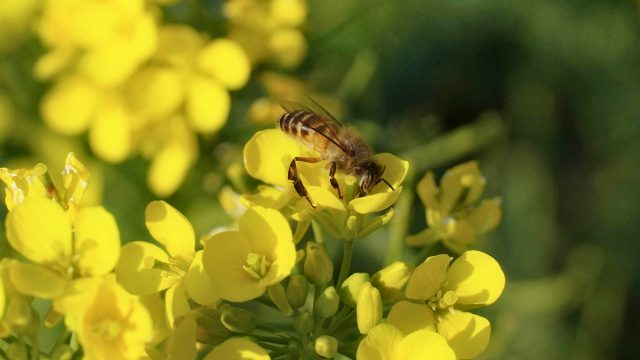
(Beyond Pesticides, May 6, 2026) Adding to the wide body of science highlighting the adverse effects of pesticides on pollinators, as extensively documented in Daily News and What the Science Shows on Biodiversity, a study published in Insects finds threats to Italian honey bees (Apis mellifera ligustica) following exposure to insecticides with contrasting toxicity levels. Both the high toxicity and low toxicity compounds impact honey bee gut bacteria and gut microbial composition, showing how even “reduced risk” insecticides can have sublethal effects and jeopardize pollinator health.
As the authors point out, “Honey bees depend on a small but highly specialized community of gut bacteria that help them digest food, resist infections, and cope with environmental stress.” Because of this, chemicals that disrupt the honey bee gut microbiome can threaten their survival. In the current study, the researchers analyze two compounds to determine adverse impacts on honey bees’ gut microbiota: emamectin benzoate-lufenuron (EB-LFR), an avermectin insecticide with high toxicity, and RH-5849 (1,2-dibenzoyl-1-tert-butylhydrazine), a non-steroidal ecdysone agonist (mimicking the action of the insect molting hormone) and insect growth regulator with reported lower toxicity.
The results reveal that both toxicity levels can harm gut microbial composition, with EB-LFR “associated with observed reductions in beneficial bacteria and the detection of opportunistic microbes” and RH-5849 “associated with a broader depletion of beneficial taxa.” This indicates that all insecticides, even those considered “reduced risk,” can impact honey bee health and further contribute to the already devastating population declines of pollinators. (See more on the “insect apocalypse” here.)
“[E]ven when acute mortality is limited, alterations in gut microbiota composition may contribute to reduced colony resilience over time,” the researchers note. The classification of RH-5849 as having low toxicity or “reduced risk” in the regulatory environment is solely based on acute toxicity, which does not take into account chronic and low-level exposure that can lead to destabilizing effects, including those addressed in this study.
Background
Honey bees provide essential ecosystem services with pollination in both natural and agricultural ecosystems, which support global food security and overall biodiversity. Despite their importance, many environmental contaminants, namely pesticides, threaten pollinator populations. “In the United States, managed colonies decreased from six million in 1947 to 2.5 million in 2022, with annual losses averaging 30%,” the study authors share. They continue: “Similar declines are reported in Asia, where the distribution of the Eastern honey bee (A. cerana cerana) has contracted by 60% due to habitat degradation and biological invasions. These losses arise from multiple interacting stressors, including parasites, pathogens, nutritional deficits, climate change, and pesticide exposure.”
As the honey bee gut microbiome relies on a highly specialized community of bacteria, disruptions to gut microbiota can have devastating effects on honey bee health. “This community exhibits functional resilience under moderate environmental stress, but severe perturbations can disrupt colonization dynamics, metabolic interactions, and immune signaling,” the researchers note. Research shows that pesticide exposure is a major driver of dysbiosis in honey bees and other organisms, highlighting the microbial imbalance and reduction in beneficial microorganisms that can occur with exposure to environmental contaminants.
Methodology and Results
To address previous knowledge gaps for acute toxicity and gut microbiota responses in bees for exposure to insecticides with contrasting toxicity profiles, the study authors subject honey bees to EB-LFR and RH-5849 and analyze microbiota composition 24 hours and 48 hours after oral and contact exposure. Higher mortality occurred throughout the 48 hours in many of the bees with higher doses of contact exposure as compared to oral exposure, indicating delayed toxic effects. Both exposure methods reveal gut microbiota response patterns in honey bees, but differ in the types of bacteria that are impacted.
In describing the results, the authors state: “EB-LFR, a highly toxic formulation, was associated with reductions in core symbionts and the detection of opportunistic taxa, whereas RH-5849, a low-toxicity ecdysone agonist, was associated with a broader reduction in beneficial bacteria… These observations are consistent with previous work showing that pesticide chemistry and mode of action can influence microbial homeostasis in bees, and they highlight the importance of considering sublethal microbial responses alongside mortality in pesticide risk assessment.”
These changes in the gut microbiome of honey bees can impact colony-level health. Once the gut microbiota composition changes from the delicate balance needed for processing nutrients, detoxification, and immune functioning, honey bee survival is threatened. This imbalance can also leave organisms more susceptible to other diseases and impact foraging efficiency.
Previous Research
In Daily News, Variability in Effect of Pesticides on Bumblebee Survival Tied to Gut Microbiome Health, research shows that different species of bees can have variation in their sensitivity to pesticide exposure, as shown with changes in their gut microbes. These varying levels are important to understand, as pesticides can severely threaten certain organisms while being considered safe in risk assessments. (See Study of Pesticide Risk in Wild Bee Species Highlights EPA Risk Assessment Inadequacies for more information.)
Additional peer-reviewed science connects pesticides, particularly neonicotinoid insecticides, to adverse effects on pollinator health. One study of ecotoxicity risk from neonicotinoid insecticides, published in Environmental Chemistry and Ecotoxicology, finds that chemicals in this class of pesticides increase the body temperature of honey bees and subsequently accelerate the translocation (movement) of contaminants into hives. (See Daily News here.) Another study of chronic toxicity of the neonicotinoid insecticide thiamethoxam to honey bees, published in Insects, finds sublethal effects that threaten the survival of bee larvae and the health of bee colonies. (See here.)
Beyond Pesticides continues to cover the regulatory deficiencies involving neonicotinoids and other pesticides, as evidenced in previous Daily News Study Cites Ban of Bee-Killing Pesticides in EU, Inaction in U.S. and Canada. This reviews the varied agricultural neonicotinoid insecticide regulation approaches regarding bans and exemption-based restrictions in the European Union, Canada, and the United States. Despite an ever-growing and overwhelming body of science linking neonicotinoids to adverse effects on pollinators and other nontarget species, all regulations fall short in protecting the environment and wildlife, further supporting the urgent need for a full transition to organic agriculture and land management practices that remove neonicotinoid exposure routes and subsequent health threats.
Support the Organic Solution
The tenuous balance seen in nature, with proper ecosystem functioning, relies on rich biodiversity. Insects, such as honey bees, are invaluable for pollination, which many plants depend on for survival and reproduction, including those in food production. The role of pollinators in global crop yields and biodiversity in natural ecosystems, however, is gravely threatened by environmental contaminants, as documented in the current study and a plethora of other scientific literature.
As a solution, organically managed systems can help protect and support pollinator populations. One study, published in Global Ecology and Conservation, builds on the breadth of existing research in recent years that underscores the adverse public health and biodiversity effects associated with a food system that is drenched in synthetic chemicals, as well as additional evidence of the ecological and economic benefits of organic agriculture. In investigating the biodiversity of agricultural landscapes in organic and non-organic areas in “bee hotels,” the researchers find that there is a positive correlation between organically managed fields and numerous indicators of improved pollinator health, including an increase in bee abundance, species richness, and diversity. (See Daily News here.)
For more information on the direct impacts of organic practices on pollinators, see Study Adds to Wide Body of Science Highlighting Benefits of Organic for Insect Biodiversity. Additional health and environmental benefits are available here and here. Take action to advance organic programs both locally, such as with the Parks for a Sustainable Future program, and across the U.S., or even right in your own backyard. Learn how to implement non-toxic lawns and landscapes and Spring Into Action!
Tell your U.S. Representative and Senators to become a cosponsor of the Opportunities in Organic Act (S. 3717/H.R. 7318). The Opportunities in Organic Act will:
- Modernize and expand Organic Certification Cost Share, covering up to $1,500 per operation per scope, with flexibility to exceed that cap for socially disadvantaged producers or regions with higher certification costs;
- Invest in organic transition and resilience, including funding for nonprofits to provide hands-on support, pass-through assistance to farmers, and help offset income losses during transition;
- Strengthen organic supply chains, including processing, storage, distribution, and market access—especially in underserved regions;
- Expand technical assistance and education, through USDA agencies, extension, universities, Tribes, and nonprofit partners, ensuring farmers nationwide can access organic expertise; and
- Provide $50 million in annual funding initially, with an increase to $100 million in 2030-2031.
You can also join Beyond Pesticides as a member, where you add your voice to the urgent movement to eliminate fossil fuel-based pesticide use within the next 10 years, help put a stop to toxic emissions and exposure, and advocate for public health and the environment. Help us continue to raise the alarm about the climate crisis, biodiversity decline, and health challenges, and promote the solution: organic agriculture and land management. Join today to be part of the organic movement!
All unattributed positions and opinions in this piece are those of Beyond Pesticides.
Source:
Kan, Y. et al. (2026) Contrasting Toxicity Classes Differentially Affect Gut Microbiota Composition in Honey Bees, Insects. Available at: https://www.mdpi.com/2075-4450/17/4/437.