24
Feb
Legislators Consider Repealing Pesticide Ban on Connecticut School Grounds
(Beyond Pesticides, February 24, 2012) On Wednesday, February 22, the Connecticut General Assembly’s Planning and Development Committee held a hearing to consider a bill that would repeal the state’s ban on toxic pesticide use on school grounds by allowing their use as part of a so-called “integrated pest management” (IPM) system. If you live in Connecticut, you can take action to fight this bill and preserve the health of school children. Current state law, adopted in 2005 and amended in 2007 and 2009 to cover facilities from day care centers up through grade 8, prohibits pesticides on playgrounds and playing fields at schools (except under emergency situations), allowing instead for non-toxic pest and fertility management. The bill currently under consideration, HB 5155, would repeal the ban, making pesticide use allowable as part of an IPM program as defined by any number of a range of bureaucratic offices.
Although IPM can be a helpful tool in the transition from a pesticide-intensive to a non-toxic management system, it makes no sense to weaken an already strong standard aimed at protecting the health of children. The effort to adopt such a system through passage of HB 5155 is being led by public works officials and groundskeepers, with support from the lawn chemical industry. They believe highly toxic pesticides are needed to make lawns and athletic fields playable, despite the success of proven organic land management practices that are effective, sustainable and protective of children’s health in Connecticut and across the country. Given the perspective of the legislation’s advocates, it can be presumed that the adoption of the new bill will result in a serious increase in the application of pesticides around schools. Nancy Alderman, president of the public interest group Environment and Human Health, Inc., spoke in her testimony against the bill about the dangers of adopting a poorly defined IPM program: “IPM allows for pesticide uses — and therefore when IPM has been mandated in other states it has proven unenforceable — because it allows pesticides — and once pesticides are allowed one cannot tell how much or how many times they are used. IPM has not proven to be a workable method when mandated for schools — and has proven to be in almost all cases — pesticide use as usual.” Additional testimony from the hearing can be found here.
Schools and day care centers must nurture a healthy environment in which children can grow and learn. Children are especially sensitive to pesticide exposure as they take in more pesticides relative to their body weight than adults and have developing organ systems that are more vulnerable and less able to detoxify toxic chemicals. Even at low levels, exposure to pesticides can cause serious adverse health effects. Numerous studies document that children exposed to pesticides suffer elevated rates of childhood leukemia, soft tissue sarcoma and brain cancer. Studies also link pesticides to childhood asthma, respiratory problems, and learning disabilities and inability to concentrate. For more information, see Beyond Pesticides’ Children and Schools page. To see more scientific research on the effects of pesticides on human health, see our Pesticide-Induced Diseases Database.
While the U.S. Environmental Protection Agency, the U.S. Department of Agriculture, Centers for Disease Control and Prevention, and the National PTA, among others, recommend schools adopt pesticide-reduction programs, without minimum federal standards, such as those contained in the proposed School Environment Protection Act (SEPA), the protection provided children is uneven and inadequate across the country. SEPA provides basic levels of protection for children and school staff from the use of pesticides in public school buildings and on school grounds by requiring schools to implement a strictly defined IPM system and identify allowed least-toxic materials as a last resort for building management and organic practices for school grounds. Contact your Congressional Representative today and ask them to support SEPA.
Aside from the serious concerns associated with pesticide use, it also should be noted that it has been repeatedly demonstrated that organic land management, when properly applied, can result in full, healthy, and weed-free turf. Organic land management is not simply a “hands-off” approach in which one is expected to sit back and do nothing to maintain the area. It requires careful fertility management, monitoring, and examination of weed and pest issues to diagnose problems, determine their source, and alter maintenance practices accordingly. Additionally, it has been shown that this approach can actually lower maintenance costs in the long term. Beyond Pesticides has numerous resources regarding research and guidance on organic lawn care.
TAKE ACTION: There are several possible next steps for HB 5155 as it makes its way through the General Assembly. The most likely course is that it will come to a full vote before the Planning and Development Committee. If you live in Connecticut, click here to send an email to the legislators on this committee and tell them that you do not want pesticides to be used on school grounds when we know that organic methods are both safe and effective.
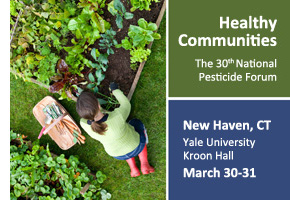
Several people deeply involved in the state fight to preserve the school pesticide ban in Connecticut, as well as other issues throughout the state, will be speaking at the 30th National Pesticide Forum on March 30-31, 2012 at Yale University in New Haven, CT. These include Nancy Alderman of Environment and Human Health, Inc., Jerry Silbert of the Watershed Partnership, and State Senator Ed Meyer, who sponsored the original school pesticide ban and who is leading the effort to allow local communities to adopt strong pesticide reduction policies, among many others. For details, including registration, travel and lodging information, go to our forum page.
All unattributed positions and opinions in this piece are those of Beyond Pesticides.