





15
May
Pesticide Contamination Moves Through the Food Web, From Aquatic Insects to Terrestrial Birds and Bats
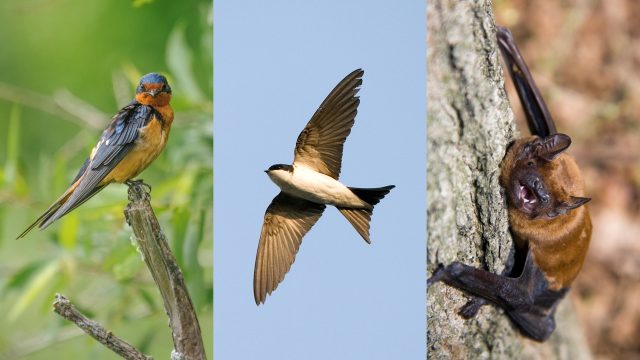
(Beyond Pesticides, May 15, 2026) As water bodies continue to be contaminated by pesticides and fertilizers used in chemical-intensive agriculture, international researchers find increasing threats to both aquatic and terrestrial food webs with insect transmission of pesticide residues from water to land. Published in Environmental Pollution, the study authors analyze insect species with complex life cycles “with an aquatic phase as larvae and a terrestrial phase as winged adults when they serve as prey for many aerial insectivores, such as bats and birds.” As the researchers explain, these insects act as vectors, transferring pesticides from water bodies into terrestrial food webs. As a result of studying feces from birds and bats that prey on these insects, the authors find residues of 16 current-use pesticides, two legacy compounds, and six metabolites (breakdown products).
The study results illustrate that pesticide contamination occurs through the ingestion of contaminated prey from aquatic systems, as all of the substances recovered in the fecal samples are detected in the water bodies within the study region. The transfer of pesticides from emerging insects to other species in the food web further threatens biodiversity and ecosystem functioning. In summary, the authors state, “Our study is among the first to assess multiple pesticide contamination of three aerial insectivores that potentially feed on aquatic insects after emergence, thus the transfer of pesticides via emerging insects needs to be acknowledged as a critical contamination route in the agricultural landscape.”
These residues are noted in barn swallows (Hirundo rustica), Western house martins (Delichon urbicum), and common noctule bats (Nyctalus noctula). In contrast, the researchers did not find pesticide residues in samples from the European starling (Sturnus vulgaris), which is a species that is known to feed primarily on terrestrial insects that do not have aquatic life cycles. This highlights how pesticide contamination in aquatic systems can impact various species throughout the food web and lead to bioaccumulation.
Study Importance
Insectivorous birds and bats rely on insect abundance and biomass, which have been in decline due to intensive pesticide use and the resulting “insect apocalypse.” As Dave Goulson, PhD says, this insect apocalypse that is occurring threatens all ecosystems. In an essay in Current Biology, he states, “Insects are integral to every terrestrial food web, being food for numerous birds, bats, reptiles, amphibians and fish, and performing vital roles such as pollination, pest control and nutrient recycling. Terrestrial and freshwater ecosystems will collapse without insects… we may have failed to appreciate the full scale and pace of environmental degradation caused by human activities in the Anthropocene.”
The cascading effects of insect population decline directly impact bird and bat populations, as insects exposed to pesticides, such as in contaminated waterways, can transmit contaminants to other organisms throughout the food web when preyed upon. “Birds and bats may ingest contaminated water directly via drinking, or they may face critical exposure via foraging on emerging aquatic insects, that can transport contaminants across ecosystem boundaries,” the researchers state. They continue: “Thus, insectivorous birds and bats are exposed to pesticides by their species-specific foraging strategies and the sites of resource allocation. This uptake of contaminated resources may either lead to trophic transfer (bioaccumulation or biomagnification) in organisms or to metabolism and subsequent excretion.”
An analysis of bird and bat feces is an indicator of pesticide exposure, as previous studies have documented. (See here, here, and here.) For more information about the impacts of pesticides on birds and bats, as well as the ecosystem services they provide, see Beyond Pesticides’ webpages here and here.
Methodology and Results
To assess pesticide contamination of four common insectivores, the study analyzes fecal samples from three passerine birds, known as “perching birds,” and one species of bat that all have different foraging strategies. As the study region is in northeast Germany, the fecal samples were tested for pesticides known to be used in the area for agriculture. “In total, 108 compounds were analyzed, comprising of 49 current-use pesticides, 23 metabolites, and 36 legacy compounds whose presence still affect ecosystems,” the authors share.
The study area, known as the ‘AgroScapeLab Quillow,’ is an area with predominantly agricultural fields, mixed forests, peatlands, and mesic meadows, and numerous aquatic habitats, including lakes, a small reservoir, and small water bodies called kettle holes. All of these water systems are documented as being intensively contaminated with pesticides. (See research here and here.)
The results reveal current-use pesticides, legacy compounds, and metabolites within the feces of two bird species and the bat species. The pesticide residues found most often, fungicides and herbicides banned in the European Union (EU) and banned or not registered for use in the U.S., are noted in 56% of the samples (155/278) from the four species tested. Most frequently detected is the fungicide prochloraz, found in 107 of the samples. The legacy compound dinoterb was detected in 46 samples, and the fungicide epoxiconazole was detected in 21 samples.
“Five substances detected (bixafen, diflufenican, dinoterb, prochloraz, simazine) are classified as critical in terms of their potential for bioconcentration and ten out of 18 detected pesticide active substances are classified to be of concern for mammal short term dietary uptake,” the researchers note. “The substances epoxiconazole and metribuzin detected in N. noctula feces are listed as showing high chronic toxicity towards mammals, while the substances epoxiconazole, flufenacet (only detected in D. urbicum), prosulfuron (not detected in N. noctula) and tebuconazole (only detected in D. urbicum) are listed as showing chronic toxicity towards birds.”
Previous Research
A wide body of research connects pesticide exposure to individual adverse effects in insects, birds, and bats, while the current study shines a light on the interconnectedness of pesticide contamination throughout aquatic and terrestrial ecosystems. Species of birds and bats provide crucial ecosystem services, including pest management. As discussed in a study featured in Daily News, entitled Nature-Based, Ecological Land Management Serves as Nonchemical Approach to Pest Suppression, researchers show how “predator-prey” relationships are established for ecological balance, and they describe the predator-pest network as a means to quantify the impact of ecosystem services. “Birds and bats consumed over 87 rice pest species in West African lowland rice fields,” according to the study published in Agriculture, Ecosystems & Environment. The authors continue, saying, “Our findings highlight the importance of maintaining and managing a diverse community of bats and birds for network resilience.”
The impacts of pesticide use on bird populations cannot ben overstated. The latest State of the Birds 2025 report finds concerning news for bird species across the country. As the article reports: “Whether they hop around the prairie, dabble in wetlands, flit through forests, or forage along the shore, birds are suffering rapid population declines across the United States… If these habitats are struggling to support bird species, it’s a sign that they’re not healthy for other wildlife, or even humans—but working to restore them will have benefits across ecosystems.” Additionally, a 2025 study in Science of The Total Environment shows pesticide residues in birds’ nests correlate with higher numbers of dead offspring and unhatched eggs. The data reveals higher insecticide levels are linked to increased offspring mortality and threaten biodiversity.
Bats provide important ecosystem services through pollination, management of pest populations, and contributing to plant resilience and productivity. The importance of bat species and their services, particularly for crop production, is invaluable. As they are the only nocturnal insect predator in the U.S. and are one of two primary nocturnal pollinators (alongside moths), bats play a crucial role for night-flowering plants and farmers. A 2022 study published in the Journal of the Association of Environmental and Resource Economists finds that bat population declines are costing American farmers as much as $495 million each year. (See Daily News here.)
Eyal Frank, PhD, an assistant professor of the Harris School of Public Policy at the University of Chicago, links increased insecticide use in croplands in the absence of bat species to a rise in infant mortality in a 2024 study. As Dr. Frank says in the study, “[B]ats do add value to society in their role as natural pesticides, and this study shows that their decline can be harmful to humans.” He continues, “As of 2024, 12 of the roughly 50 insectivorous bat species in the US are negatively affected by WNS [white-nosed syndrome].” This study calls attention to the observable and statistically significant increases in insecticide use in counties that document WNS compared to non-WNS counties, with increased infant mortality also occurring in those areas. (See Daily News here.)
The Organic Solution
Now is the time to act to protect all species—from insects, including pollinators, to birds, bats, other wildlife, and humans. In order to safeguard the environment and public health, a wide-scale transition to organic agriculture is needed. Take action: >> Ask the U.S. Senate to hold the line and reject the House Farm Bill, pass a clean bill that extends the current law, and regroup to build a sustainable agricultural sector that respects farmers, farmworkers, consumers, and the environment.
The bill, according to advocates, is so fundamentally flawed that they are asking the Senate to reject it and extend the current law with a “clean bill,” free of all controversial amendments that have been characterized as poison pills. Overall, critics say, the House Farm Bill increases dependency on petrochemical fertilizers (which contribute to escalating toxic pesticide use), ignores hunger (despite a historically large $186 billion cut to the Supplemental Nutrition Assistance Program/SNAP), dismisses the notion of a fair, responsible, and accessible family farm safety net, and rolls back successful conservation investments. (See more here.)
During these times, Beyond Pesticides urges sending a message even to those who have a record of refusing to listen. As we strive to adopt the changes essential for a livable future, we must create a record that is based on science, even when the science and the facts are dismissed by those in power. To this end, the failure of action to address the existential health, biodiversity, and climate crises by those in Congress and the administration empowers lower levels of government and some corporations to step into the void left by those whose actions or inaction threaten life.
All unattributed positions and opinions in this piece are those of Beyond Pesticides.
Source:
Lorenz, S. et al. (2026) Species-specific aquatic habitat use predicts pesticide residues in feces of insectivorous birds and bats, Environmental Pollution. Available at: https://www.sciencedirect.com/science/article/pii/S0269749126005762.





We need to get rid of all pesticides. Pesticides ruin ecosystems, poison our water, kill animals, and ruin our soil.
May 28th, 2026 at 7:28 am