





12
Apr
Fish and Wildlife Service Sued for Failure to Disclose Use of Bee-Toxic Pesticides and GMO Crops in Wildlife Refuges
 (Beyond Pesticides, April 12, 2019) The Center for Biological Diversity (CBD) announced on April 3 that it is suing the U.S. Fish and Wildlife Service (FWS) for its failure to release public records, despite multiple FOIA (Freedom of Information Act) requests, that would reveal on-the-ground impacts of FWS allowing use of neonicotinoids and genetically engineered (GE) crops in wildlife refuges. Last August, in yet another rollback of protections for wildlife, the environment, and public health, the Trump administration reversed a 2014 FWS decision to ban the use of neonicotinoids and GE crops in National Wildlife Refuges. If successful, the CBE lawsuit, filed in U.S. District Court for the District of Columbia, would compel the agency to provide the requested documents. This would allow the public, largely through the work of NGO (non-governmental organization) watchdogs, such as CBD and Beyond Pesticides, to understand what harms are being caused on the nation’s protected public lands by the administration’s reversal of the 2014 ban.
Hannah Connor, a CBD senior attorney, said, “The goal of the lawsuit is to get them to comply with the Freedom of Information Act and produce the records that have been requested. . . . We aren’t asking them to go above and beyond. We’re just asking them to comply with the law and bring some transparency to this process.” She also commented, “Pesticide-intensive farming has no place on America’s national wildlife refuges. The public has a right to know where and when these dangerous practices are being allowed to poison our refuges. These incredibly precious places were set up to protect wildlife, not industrial-scale commercial agriculture.”
Ms. Connor also noted, in The New Food Economy’s coverage of the matter, that CBD has encountered delays in getting documents via FOIA requests with past administrations, but has never faced a delay as protracted as this one with FWS. It is noteworthy and likely relevant that in December 2018, the Department of the Interior, under whose auspices FWS operates, submitted to the Federal Register proposed rule changes that could limit the number of FOIA requests an individual could submit, lengthen the turnaround for FOIA requests, and establish a level of “burden” that requesters should not exceed. This was done during a government shutdown without any public announcement or press release by the agency.
In 2014, advocates welcomed the announcement, by FWS, that it would ban neonicotinoid insecticides from all wildlife refuges nationwide by January 2016, as well as phase out the use of GE crops. The decision followed years of lawsuits and an intensive advocacy campaign by CFS, Public Employees for Environmental Responsibility (PEER), and Beyond Pesticides. It was a hopeful sign, in that FWS was the first federal agency to restrict the use of neonicotinoids based on the principle of precaution. At the time, Beyond Pesticides Executive Director Jay Feldman commented, “The FWS decision represents an important and responsible departure from EPA’s decision to allow the widespread use of neonicotinoids despite the non-target effects to managed and wild bees and other beneficial organisms.”
Then came the 2018 FWS announcement of the reversal, in which FWS said that genetically modified seeds, used together with neonicotinoids, “[maximize] crop production” — pointing to the friendliness the Trump administration exhibits toward industry, in this case, the agrochemical sector, and to its relative indifference to environmental, public, and wildlife health. Very soon after that announcement, CBD and the Center for Food Safety (CFS) sued the administration over the reversal, citing the FWS’s failure to consider the risks of increased pesticide use for threatened species that rely, for food, habitat, and protection, on national wildlife refuges. Earlier in 2018, CBD released a report, No Refuge, that documented the intensive use of pesticides on lands designated as refuges for wildlife and protected under U.S. law.
That use amounted, in 2016 alone, to 490,000 pounds of pesticides sprayed on crops grown in national wildlife refuges. As of that year, the refuge systems that endured the heaviest use of pesticides were the Klamath Basin National Wildlife Refuge Complex, the Central Arkansas Refuge Complex, the West Tennessee Refuge Complex, the Tennessee National Wildlife Refuge Complex, and the Chesapeake Marshlands National Wildlife Refuge Complex. Intensive commercial farming — and use of pesticides — have spiked with the advent of GE crops, such as corn and soybeans. Increased pesticide use threatens the long-term health of these sensitive habitats and the wildlife that depend on them.
Beyond Pesticides wrote, back in 2012: “Farming has long been used on national wildlife refuges for multiple purposes like habitat restoration, which involves destroying invasive species to make room for native plants. However, in recent years, refuge farming has been converted to GE crops because the agency claims GE seed is the only seed farmers can obtain today. These GE crops are mostly engineered for a single purpose: to be resistant to herbicides, mainly Monsanto’s ubiquitous Roundup. Because the crops are tolerant to herbicides, their plantings lead to more frequent applications and increased amounts of toxic herbicides. This overreliance on herbicides used in GE cropping systems has fostered an epidemic of herbicide-resistant ‘superweeds’ in the past decade as weeds have mutated.”
The 2014 ban would have protected wildlife broadly, as well as honeybees, bumblebees, and other pollinators, from the impacts of neonicotinoids, which are primarily implicated in the devastation of pollinator populations, as well as the federally threatened and endangered pollinators that live in National Wildlife Refuges. These compounds are also contributing to the dramatic drops in overall insect abundance, which some scientists label as a coming “insect apocalypse.” Research has identified astonishing reductions in insect “biomass,” including that there were, in the 1970s, 60 times as many insects in some locations as there are currently, and that more than 75% of the insect decline occurred from 1990–2017. As Beyond Pesticides has noted, “pesticide use in these sensitive areas poses risks to pollinators, aquatic organisms, migratory birds, and other wildlife on refuges that were created to protect them.”
The Beyond Pesticides Daily News Blog is a great source for timely news on pesticide issues, including emerging research, developments in legal and governmental rulings, and efforts by localities and grassroots organizations to protect human and environmental health and integrity. Look for opportunities to advocate for less-toxic approaches to pest management in agriculture, homes and buildings, gardens, public and private lands, and more, through Beyond Pesticides’ Action of the Week.
All unattributed positions and opinions in this piece are those of Beyond Pesticides.

 (Beyond Pesticides, April 11, 2019) A
  (Beyond Pesticides, April 10, 2019) Last month, the Washington State Senate unanimously passed HB 1906, designating April 10 as Dolores Huerta Day. In July of 2018, a similar California law proclaimed April 10 Dolores Huerta Day in that state. In an interview with Vida del Valle, Ms. Huerta stated, “I’m happy to hear that our young learners will have the opportunity to learn more about social justice and civil rights, because there is still a lot of work to do by the Dolores Huerta Foundation.”
 (Beyond Pesticides, April 8, 2019) Officials in Europe and the U.S. focus on banning problem pesticides, raising concerns about their replacements in the face of pesticide-intensive management strategies, while organic advocates call for a systems change in land management. In reference to widespread community bans of Roundup/glyphosate, Cary Gillam, author of Whitewash, told last year’s Beyond Pesticides’ Forum, “Glyphosate is the poster child for the bigger pesticide problem.” She continues, “If it goes away tomorrow, we are not okay.” Because of this, Beyond Pesticides has strategically sought to transform our country’s approach to pest management, both agricultural and residential/structural, by eliminating a reliance on pesticides and advancing organic management practices that do not rely on toxic inputs. This
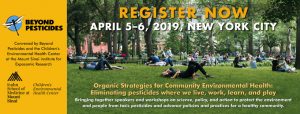
  (Beyond Pesticides, April 5, 2019) Beyond Pesticides’ 37th National Pesticide Forum,
  (Beyond Pesticides, April 4, 2019) Contamination of drinking water with toxic breakdown products and risks to fish and and amphibians has led to a ban on the fungicide
  (Beyond Pesticides, April 4, 2019) Following on its
  (Beyond Pesticides, April 2, 2019) Throughout the month of April, and in celebration of Earth Day on April 22, Natural Grocers is inviting the community
  (Beyond Pesticides, April 2, 2019) The new documentary film “Ground War” will have its New York City premiere screening on Saturday, April 6, 2019, 7:30pm at Florence Gould Hall, 55 East 59th Street, New York, NY. The film is a moving depiction of a son’s quest for answers about the cause of his father’s cancer—which takes him into the world of doctors, scientists, pesticide regulators, victims of pesticide poisoning, activists, and land managers. The issue is exposure to pesticides used to manage lawns and playing fields and the father’s exposure as an avid golfer. The son, who is the filmmaker, finds others on the same search for answers because of harm or death of a loved one, then finds a solution in the work of activists and organic land managers.
 (Beyond Pesticides, April 1, 2019) National Organic Standards Board (NOSB) meets next month in Seattle, Washington to debate issues concerning what goes into your organic food. Written comments are due April 4. The format for messaging the NOSB requires copying and pasting comments into regulations.gov, so we apologize that this is not a “single click” action. Please add a personal message about why this is important to you at the top of your comments, if possible.
 (Beyond Pesticides, March 29, 2019) The U.S. Environmental Protection Agency (
 (Beyond Pesticides, March 28, 2019) A set of documents obtained by the Center for Biological Diversity reveals that the Trump administration has known for over a year – and actively concealed – that the organophosphate insecticide chlorpyrifos jeopardizes the existence of 1,399 endangered species. Top officials at the U.S. Department of the Interior, including Acting Secretary David Bernhardt, were privy to and prevented the release of a “biological opinion,” completed by the Fish and Wildlife Service (FWS) in 2017, which contains a full analysis of the extensive environmental impacts wrought by three organophosphate insecticides.
 (Beyond Pesticides, March 27, 2019) Exposure to commonly used pesticides in the womb and during the first year of life is linked to a higher risk of developing autism, according to the study, “Prenatal and infant exposure to ambient pesticides and autism spectrum disorder in children: population based case-control study,”
 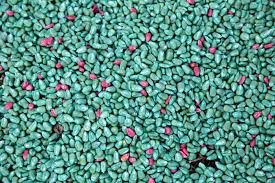 (Beyond Pesticides, March 25, 2019) EPA is using a regulatory loophole – the “treated articles exemption” – to allow systemic insecticides to be used in mass quantities, without regulating or labeling them as required under the Federal Insecticide, Fungicide and Rodenticide Act (FIFRA). EPA does not currently assess adverse effects on the environment and public health caused by widespread use of neonicotinoid insecticides delivered through seeds coated with the insecticides, resulting in widespread exposure to one of the most environmentally damaging classes of chemicals on the market.
 (Beyond Pesticides, March 22, 2019) A
  (Beyond Pesticides, March 21, 2019) Corporate food giant General Mills has thrown some weight behind regenerative agriculture, committing to converting one million acres of farmland to regenerative practices by 2030. Some – but not all – of the initiative involves organic land management.
 (Beyond Pesticides, March 20, 2019) In a second verdict against Bayer/Monsanto yesterday, a jury found unanimously that a California man’s non Hodgkin lymphoma (NHL) was substantially caused by the herbicide glyphosate (Roundup). The case being heard in federal court in San Francisco now moves to the damages phase. Last August in
 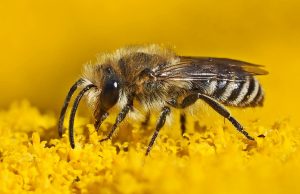 (Beyond Pesticides, March 19, 2019) Research is beginning to explain how systemic neonicotinoid insecticides affect often overlooked species of ground nesting bees. While much of the current scientific literature has focused on the impacts of pesticides to bumblebees and honey bees, a study,
 (Beyond Pesticides, March 14, 2019) A



.png)