





14
Mar
Study Finds Public Health Threatened by State Laws that Preempt Local Government Authority to Restrict Pesticides Community-wide
 (Beyond Pesticides, March 14, 2019) A study, supported by the USDA’s National Institute of Food and Agriculture, finds that state pesticide preemption laws “compromise public health and economic well-being” by preventing localities from enacting pesticide use restrictions on private property that are more restrictive than their state’s regulations. In the words of the authors, “By eliminating the ability of local governments to enact ordinances to safeguard inhabitants from health risks posed by pesticides, state preemption laws denigrate public health protections.”
The study, Anti-community state pesticide preemption laws prevent local governments from protecting people from harm, published in the International Journal of Agricultural Sustainability, reviews scientific and historical evidence of the failure of state and federal pesticide laws to protect localities from pesticide poisoning, and highlights the inability of localities to compensate for that failure under present laws. Communities seeking to protect their residents would typically issue community-wide restrictions to ensure protection of shared community resources, including air, land, and waterways, from pesticide drift, runoff, and other nontarget effects —as is the case with other community decisions on recycling, smoking, and zoning. The study’s authors document how industry influence led to the adoption of state laws that undermine the ability of localities to enact protective pesticide standards they determine are necessary to protect public health and the environment. In the absence of this broad public and environmental health authority, localities focus on the management of public property, including parks, playing fields, schools, and rights-of way.
Drawing on Beyond Pesticides’ research and long-standing involvement in this issue, as well as other independent studies, the authors trace the history of state preemption. In 1991, the Supreme Court decision in Wisconsin Public Intervenor vs. Mortier affirmed the right of local governments to restrict pesticides on private and public property under federal pesticide law, the Federal Insecticide, Fungicide, and Rodenticide Act (FIFRA), with federal and state law serving as a floor for minimum protective standards. However, over several years beginning in 1993, groups representing industry successfully lobbied state legislatures in 43 states to override local authority. In the words of the study authors, “For the past 50 years, agricultural interest groups have supported anti-community preemption laws covering a variety of topics because they interfered with business arrangements and tended to increase costs.”
Currently, twenty-nine states have explicit preemption, and only six states are free of state preemption law. Most of the state laws defining preemption use nearly identical preemption language that explicitly preempts local authority. Most states’ preemption clauses read similar to the American Legislative Exchange Council’s (ALEC) Model State Pesticide Preemption Act, which states,
“No city, town, county, or other political subdivision of this state shall adopt or continue in effect any ordinance, rule, regulation or statute regarding pesticide sale or use, including without limitation: registration, notification of use, advertising and marketing, distribution, applicator training and certification, storage, transportation, disposal, disclosure of confidential information, or product composition.”
The authors cite previous work by their own as well as other research groups, finding that the most frequent justification for these state preemption laws is the desire for “economies of scale,” centralizing control and thereby minimizing “costly administrative redundancy.” Based on evidence of industry influence over state policies, the researchers hold the position that these justifications are a guise for more perverse economic motivations.
Another common justification for state preemption laws, put forward for example by ALEC, is that state control prevents localities from electing less restrictive or less protective policies. Authors note that this position is false, as localities would still have to follow federal law, thus precluding the establishment of less protective local laws.
The study delivers the clear message that when it comes to protections, more expansive local authority is actually needed. In their discussion, the researchers highlight several specific areas of pesticide regulation that demonstrate a clear need for local restrictions to increase protections. Citing the 2017 EPA decision to forgo revoking chlorpyrifos tolerances, for example, authors suggest that localities should be able to enact protections to prevent local exposure to one of the most neurologically toxic pesticides on the market.
Researchers highlight the need for protective policies that account for geographic and demographic conditions unique to a given locality. Referencing the endocrine disrupting effects of atrazine-contaminated drinking water on pregnant women and fetuses, for example, the authors argue that communities with young families should have the authority “to safeguard pregnant mothers from the risks of preterm delivery” by setting their own restrictions. Similarly, chlorpyrifos bans are particularly important for localities dominated by agricultural land, where use is still prevalent. Chlorpyrifos was banned from residential use in 2000, but because of ongoing farm use of this potent brain-damaging chemical, communities in rural, agricultural areas are still heavily exposed.
As the discussion makes clear, the impact of repealing state preemption laws, or preventing their further spread, would be far-reaching. Localities could enforce stronger protections for pollinators by enforcing stricter restrictions of neonicotinoids, for example. Local jurisdictions could ban the use of glyphosate based on extensive evidence for its link to non-Hodgkin lymphoma. Rural districts where farmers are suffering losses due to herbicide drift could enact stricter limits on the use of herbicides such as dicamba.
Indeed, in those few states that do not restrict locality authority over pesticide use, there are classic examples of a democratic decision making process yielding increased public health and environmental protections. A number of localities have restricted pesticide use on public and private property. Montgomery County recently banned the use of glyphosate-based herbicides in parks, in advance of a complete ban throughout the community. A 2015 Montgomery County ban limits allowable turf management pesticides (on public or private property within the county’s jurisdiction) to those permitted for use in organic production, or identified by the Environmental Protection Agency (EPA) as “minimum risk pesticides” under FIFRA. Takoma Park, a city within Montgomery County, passed a similar ordinance in 2013, as did Ogunquit, Maine in 2014. South Portland, Maine followed Ogunquit by roughly a year, as did Portland, Maine (2018) in passing an ordinance quite like Montgomery County’s 2015 “public and private” ban. And where local authority is limited, communities are taking action to restrict pesticide use on public land. In September 2018, Miami Beach instituted a ban, similar to bans in dozens to communities nationwide, on any use of glyphosate-based herbicides by city employees and contractors in landscaping and maintenance work on all city-owned properties.
Working with local elected officials nationwide, and in collaboration with other organizations, Beyond Pesticide successfully pushed to remove a provision in the 2018 Farm Bill that would have amended FIFRA to preempt local jurisdictions from restricting pesticides. This protects the status-quo, as many states consider repealing preemption law in their states. In 2017 in the state legislature of Maine, a state that affirms local authority to restrict pesticides community-wide, the chemical industry unsuccessfully pushed to institute preemption and take away local authority that numerous jurisdictions have exercised.
Beyond Pesticides looks toward a future when federal, state, and local governments are all accountable to the people they serve; when pesticide use across the board is recognized as unacceptably hazardous; when agrochemicals are rendered unnecessary due to the regeneration of healthy soils and resurgence of beneficial insect and microbial communities brought about by the widespread adoption of organic practices; when health is a right and not a choice for some. As a step toward that endpoint, localities must be able to build the models we need to follow nationally and globally to ensure our future on this planet.
Join Beyond Pesticides in advocating for local authority to enact stronger protections against pesticide use. Inform yourself of your own state’s preemption status by consulting our State Preemption Law page, and stay abreast of the latest updates by following the Beyond Pesticides Daily News Blog.
All unattributed positions and opinions in this piece are those of Beyond Pesticides.
Source: Anti-community state pesticide preemption laws prevent local governments from protecting people from harm. Centner and Heric, 2019.

 (Beyond Pesticides, March 13, 2019) A study on the impact of two neonicotinoid pesticides shows differential gene expression in bumblebees (Bombus terrestris) after exposure. Considering the current
  (Beyond Pesticides, March 12, 2019) Fifty years after the end of the Vietnam War, the Agent Orange byproduct dioxin continues to contaminate Vietnam’s soils and wildlife, and subsequently affect human health. In
 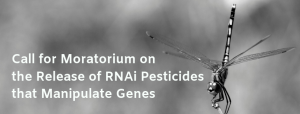 (Beyond Pesticides, March 11, 2019) We must stop the expanded commercialization of genetically engineered pesticides. The failure of the U.S. Environmental Protection Agency (EPA) to fully evaluate environmental impacts of gene-manipulating pesticides raises serious concerns in light of the agency’s ongoing failure to predict ecological effects of pesticides, such as the dramatic decline of pollinators.
 (Beyond Pesticides, March 8, 2019) Researchers from the U.S. and Switzerland have
  (Beyond Pesticides, March 7, 2019) A
 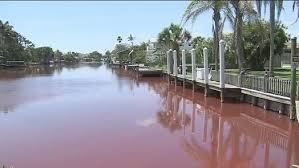 (Beyond Pesticides, March 6, 2019) After a brief hiatus, Florida Fish and Wildlife Conservation Commission (FWC) is continuing use of aquatic herbicides, including glyphosate, for invasive species management. Public pressure and feedback caused FWC to take a
  (Beyond Pesticides, March 5, 2019) Wild, edible plants subject to drift from the herbicide glyphosate during forestry operations can be contaminated with the chemical an entire year after an initial application, according to a
  (Beyond Pesticides, March 4, 2019) Last week, U.S. Representative Earl Blumenauer (D-OR) reintroduced the
 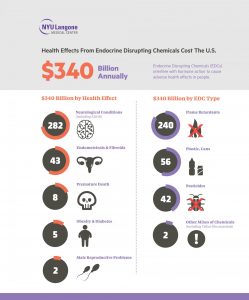 (Beyond Pesticides, March 1, 2019) The costs of pesticide use extend far beyond the invoices farmers pay for purchase of the chemicals to use on their crops. The real costs related to pesticide use and exposure include those of health care, lost productivity and income, and environmental damage (loss of environmental services and biodiversity; compromised air, water, and soil quality). There has been relatively little research focused on those real and extensive costs; this
  (Beyond Pesticides, February 28, 2019) Earlier this month, a team of U.S. scientists
  (Beyond Pesticides, February 27, 2019) U.S. PIRG tested 20 common beers and wines and found glyphosate residues in all but one. Glyphosate, the active ingredient in Roundup, is the most commonly used agrichemical in the world. Though it is linked to many health and environmental issues, there is no current EPA limit for glyphosate residues in beer or wine. The U.S. Department of Agriculture (USDA) does not regularly test for glyphosate on either food or beverages.
 (Beyond Pesticides, February 26, 2019) Breakfast cereal, apples, applesauce and pinto beans made and sold by Kroger contain residues of toxic pesticides linked to a range of series health and environmental problems, according to a
 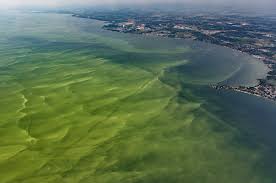 (Beyond Pesticides, February 22, 2019) Lake Erie, the 11th largest freshwater lake in the world, is once again plagued with pollution, although in this decade it is due primarily to agricultural runoff — as opposed to the raw sewage and industrial effluents that afflicted it in the mid-20th century. Concerned and weary Toledo, Ohio residents are seeking remedies through the adoption of a
  (Beyond Pesticides, February 21, 2019) In 2018, the Environmental Protection Agency (EPA)
 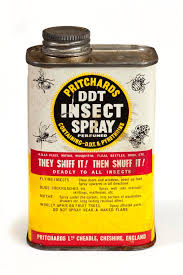 (Beyond Pesticides, February 20, 2019) Women exposed to DDT during ‘early windows of susceptibility’ in their childhood are at increased risk of developing breast cancer, according to
  (Beyond Pesticides, February 19, 2019) At the request of Beyond Pesticides, the Environmental Protection Agency (EPA) has extended its public comment period on antibiotics in citrus production until March 14. With this extra time, please share this action widely to stop this threat.
 (Beyond Pesticides, February 15, 2019) A
  (Beyond Pesticides, February 14, 2019) Over the course of the last two weeks in Bavaria – a southern state of Germany – locals rallied in an effort to save the bees.
  (Beyond Pesticides, February 11, 2019) A new
 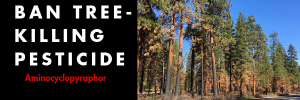 (Beyond Pesticides, February 11, 2019) Aminocyclopyrachlor (ACP) is a tree-killing pesticide masquerading as a broadleaf herbicide. The Oregon Department of Agriculture (ODA) has the opportunity to lead the country in banning this inherently dangerous chemical. According to ODA, nearly 1,500 dead or dying trees have been reported along Oregon’s iconic Interstate 20, home to old growth ponderosa pines. Many of these 150- to 300-year old trees are now dead from ACP exposure. ODA indicated that “because [ACP] is a relatively new herbicide it is unknown how many trees stressed from past applications of [ACP] will die in the future.”


