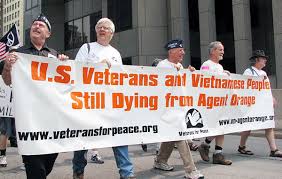
 (Beyond Pesticides, September 4, 2018) Close on the heels of the recent landmark California decision against Monsanto, maker of the glyphosate-based pesticide Roundup, Vietnam has demanded that the company pay damages to the many victims of its Agent Orange herbicide and defoliant, which Monsanto supplied to the U.S. military during the Vietnam War. (Monsanto was not the only U.S. manufacturer of the compound; there were nine in total.) U.S. forces, in a program dubbed Operation Ranch Hand, used more than 13 million gallons of the compound in Vietnam — nearly one-third of the 20 million gallons of all herbicides used during the war in Laos, Cambodia, and Vietnam. In Vietnam alone, 4.5 million acres were impacted by Agent Orange.
Nguyen Phuong Tra, a spokesperson for Vietnam’s foreign ministry, said, “The [U.S.] verdict serves as a legal precedent which refutes previous claims that the herbicides made by Monsanto and other chemical corporations in the U.S. and provided for the U.S. army in the war are harmless. . . . Vietnam has suffered tremendous consequences from the war, especially with regard to the lasting and devastating effects of toxic chemicals, including Agent Orange.”
Around the world, the U.S. case may be sparking bolder actions on the toxic weed killer. In that watershed decision, the jury in San Francisco County Superior Court awarded Dewayne “Lee” Johnson $289 million in compensatory and punitive damages for his exposure to Monsanto’s Roundup (whose active ingredient is glyphosate) that caused his subsequent development of non-Hodgkin’s lymphoma, as well as for the corporation’s deliberate and protracted cover-ups to keep the risks of exposure to glyphosate hidden from the public and regulators.
Agent Orange got its moniker because of the color of the band around the 55-gallon drums in which the chemical was transported. Other herbicides used by U.S. forces in Vietnam were identified as Agents White, Blue, Purple, Pink, and Green. The Orange version — comprising 2,4-D (2,4-dichlorophenoxyacetic acid, still widely used as a broadleaf herbicide) and 2,4,5-T (2,4,5-trichlorophenoxyacetic acid) — was used to defoliate food crops and forest cover used by North Vietnamese and Viet Cong troops during the Vietnam War. The toxic compound was sprayed heavily on forested areas, farmland and rice paddies, waterways, and roads. Military members — numbering approximately 2.6 million — were not the only people potentially exposed; crops and water sources used by non-combatant South Vietnamese people were also affected.
The compound contained significant amounts of the synthetic contaminant dioxin (2,3,7,8-tetrachlorodibenzo-p-dioxin), often called TCDD. Dioxins are highly toxic chemicals that persist for years in the environment (especially in soils, lake and river sediments, and the food chain), and accumulate in fatty tissues of animals. Dioxins are carcinogenic, toxic even at very low exposure levels, and responsible for both acute and long-term effects. They have been proven to cause not only cancer, but also, other grave health problems, such as birth defects, extreme rashes (chloracne and related conditions), and severe neurological and psychological issues. This has been true for both Vietnamese military and civilian people who were exposed, and for U.S. Vietnam-era service members. It should be noted that those in the military are not the only workers impacted by TCDD; workers in other sectors have registered health effects, including employees in pesticide manufacturing and transport facilities, farm and forestry operations, and pulp and paper mills.
Many Vietnam Era service members have long charged Agent Orange with responsibility for a host of maladies they suffered both in the field, and in the years after their return stateside. They began to link their exposures to Agent Orange with the myriad chronic health issues some were developing. In 1979, the first class action suit was brought against five manufacturers (with more added to the suit later on) in the U.S. District Court for the Southern District of New York. The suit was brought by the class comprising Vietnam veterans, and their spouses, parents, and children; it did not name the federal government as a third-party defendant. (A 1950 U.S. Supreme Court case gave rise to the Feres doctrine, which prevents claims against the federal government by armed forces members and their families for injuries arising from, or in the course of, activity incident to military service.) The outcome was a settlement in the form of a $180 million fund to be used to: (1) provide cash payments to totally disabled veterans and survivors of deceased veterans; (2) establish a class assistance foundation to help meet the medical, social, and legal service needs of members of the class; and (3) establish a trust fund for New Zealand and Australian class members. Because a settlement was made out of court, no determination of the causal relationship between Agent Orange exposure and veterans’ health outcomes was made.
Subsequently, beginning with the first claims the Veterans Administration (VA) received related to Agent Orange in 1977, veterans’ groups and other advocates have worked persistently to get recognition for the harms of Agent Orange to veterans — and in some cases, to their children — as well as coverage for medical needs and disability. It has been, no doubt, a maddening journey, with repeated delays in progress and glacially incremental expansion of coverages.
Any federal attempt to deal with coverage for exposed veterans started with the 1984 Congressional passage of Public Law 98-542, which “provide[d] compensation to Vietnam veterans for soft tissue sarcoma and require[d] the VA [U.S. Department of Veterans Affairs] to establish standards for Agent Orange and atomic radiation compensation” (which law the VA has been charged with largely ignoring). This was followed by a 1989 order, by a federal judge, that the VA reconsider 31,000 Vietnam Era vets’ claims related to health impacts of exposure, and the Agent Orange Act of 1991, which established that certain diseases tied to chemical exposure would be presumed related to a veteran’s military service and would make such veterans eligible for benefits.
This act really marked the beginning of at least passive acknowledgement, by the federal government, that its use of Agent Orange was causal of many health problems. The health issues covered by this “presumption policy” has grown over time to include: non-Hodgkin’s lymphoma, soft-tissue sarcoma, and chloracne (1991); multiple myeloma, respiratory cancers, Hodgkin’s disease, and porphyria cutanea tarda, a metabolic disease (1994); type II diabetes (2001); chronic lymphocytic leukemia (2003); AL amyloidosis (2009); chronic B-cell leukemias, Parkinson’s disease, and ischemic heart disease (2010); prostate cancer (2015); and peripheral neuropathy (2016). VetsHQ is an online veterans’ community that describes its mission as “helping ensure America’s commitments to veterans and their families are honored.” Its website provides many tools for vets, and a very useful timeline of significant events in the Agent Orange saga.
A 2018 update on coverage from the VA is available here. The agency reported in June of this year that its presumption policy — which sets out the diseases or syndromes that are assumed related to Agent Orange exposure — has resulted in increased utilization of VA healthcare benefits by veterans. The agency notes that a study by researchers from the War Related Illness and Injury Study Center (WRIISC) at the VA New Jersey Healthcare System found that the “law passed by Congress nearly 30 years ago [the Agent Orange Act of 1991] has largely met its goal: helping affected Veterans get the care they need.”
Yet progress in veterans receiving the support they need has been interspersed with plenty of setbacks, including denials of claims, government statements of inconclusive causation, and delays or failures of potentially helpful legislation. For example, until 2015, military personnel who worked in, on, or around the C-123 — the aircraft that delivered Agent Orange in Vietnam and elsewhere in Asia during or after the Vietnam War — were deemed ineligible for medical care and disability coverage for their exposures. These contaminated transport aircraft were never decontaminated after their Southeast Asia service, and some were repurposed, back in the U.S., for basic transport operations, such as cargo shipping and medical evacuation missions.
The VA had declared that “dried residues” of Agent Orange in these C-123s were likely not harmful, but a 2014 study showed that people who worked on or around the C-123 were very likely to have been exposed to dioxin from those residues. Beyond Pesticides reported, in June 2015, that things were looking more hopeful, saying, “After years of denial and obstruction, Air Force and Air Force Reserve veterans now have the chance to receive compensation for their exposure to the highly toxic herbicide Agent Orange on contaminated aircraft used after the Vietnam War.” In that year, 1,500–2,100 service members did gain eligibility for coverage.
A further example of the difficulties veterans have had and continue to have: as Pro Publica reported in 2015, the 1991 Agent Orange Act made eligible for benefits veterans with certain diseases who “‘must have actually set foot on Vietnamese soil or served on a craft in its rivers (also known as “brown water veterans”),’ according to the Congressional Research Service. . . . Those who instead spent time on deep-water Navy ships (called ‘Blue Water Navy’ veterans) do not qualify unless they can show that they spent time on Vietnam land or rivers.” Now, in 2018, a U.S. House of Representatives bill (HR 299) that would extend Agent Orange disability benefits and health care to 70,000–90,000 veterans who served aboard ships in territorial waters off Vietnam during the war, passed the House unanimously, but is being opposed by the VA, which is urging the Senate to quash it.
Paul R. Lawrence, VA Undersecretary for Benefits, testified that “There’s still no credible scientific evidence to support extending Agent Orange-related benefits to shipboard personnel who never went ashore in Vietnam or patrolled its rivers. Without such evidence, he said, it would be wrong, and would create a disastrous precedent, to award VA benefits.” Although David Shulkin, the first VA secretary under the Trump administration, had said, one year into the job, “These veterans have waited too long and this is a responsibility that this country has. . . . It is a high priority for us,” the scorching comment from Mr. Lawrence came days after the subsequent secretary, Robert Wilkie, assumed the secretary post.
Pro Publica offers a helpful guide to which groups are covered for Agent Orange–related issues, or are seeking coverage. Those groups include: those who served in Vietnam; Air Force personnel exposed to contaminated C-123 aircraft; Blue Water veterans; those who served in or near the Korean DMZ (demilitarized zone), 1968–1971; Air Force personnel who worked in Thailand, 1961–1975; and children of veterans. Currently, kids of Vietnam Era vets with spina bifida qualify for benefits, and children of female vets qualify if they suffer from 18 other various conditions. There may be coming research on potential epigenetic effects on children of veterans that could add others to the coverage list.
Halfway across the world, people in Vietnam are dealing with many of the same health, never mind environmental (such as persistence of dioxin in the food chain) issues. In 2012, as Beyond Pesticides reported, the U.S. launched its first major effort to address environmental contamination brought on by its use of Agent Orange during the Vietnam War — after decades of denying Vietnamese requests for assistance in a cleanup. Five years later, PBS reported a mixed picture, and perhaps waning commitment, on keeping on top of that task, given costs. Whether Vietnam’s latest attempt to achieve some justice for its affected people bears future fruit — in what may, in light of the recent California award, be a changing landscape on corporate culpability for harms to human health — will be a development eagerly awaited by that country, and by advocates for policies on toxic chemicals that will actually protect people and our environments.
For more information about the legacy of Agent Orange, see Beyond Pesticides’ Pesticide Induced Diseases Database.
All unattributed positions and opinions in this piece are those of Beyond Pesticides,
Primary source: https://www.independent.co.uk/news/world/asia/vietnam-agent-orange-monsanto-victims-compensation-a8508271.html






 (Beyond Pesticides, October 2, 2018) The U.S. Environmental Protection Agency (EPA) is asking an appeals court to rehear a case that previously ruled EPA must immediately ban the brain-harming pesticide chlorpyrifos. The agency is requesting the U.S. Court of Appeals for the Ninth Circuit in San Francisco convene an “en banc hearing,” which is a session held in front of the all judges in the court, rather than a panel of three judges. An “en banc” request is generally only accepted when an issue conflicts with a previous court decision, or is of significant importance for the general public.
 (Beyond Pesticides, October 1, 2018) Last year, pesticide manufacturers tried to undo local pesticide ordinances in a large state-by-state lobbying effort. That failed. Now they are trying to get Congress to undo these local rules in one fell swoop through an amendment in the Farm Bill.
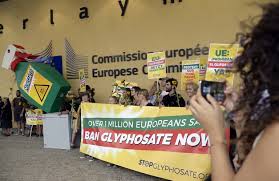 (Beyond Pesticides, September 28, 2018) Despite French President, Emmanuel Macron’s pledge to see glyphosate banned in his country, French ministers of parliament (MPs) have once again refused to enter the banning of glyphosate into legislation. Glyphosate’s use in Europe has come under scrutiny and heated debate. But despite evidence of harms, and interference by Monsanto, the European Union (EU) extended its license last year. However, France has pledged to ban the chemical within a few years.
 (Beyond Pesticides, September 27, 2018) The U.S. Environmental Protection Agency’s (EPA) Office of the Inspector General (OIG) released a
 (Beyond Pesticides, September 25, 2018) Last week the pioneering yogurt maker
  Beyond Pesticides, September 24, 2018) In a move that critics fear may be a pretext for gutting federal agricultural research, U.S. Secretary of Agriculture Sonny Perdue has proposed overhauling two federal offices overseeing food and agriculture research and moving them out of the Washington, DC area. A plan announced in August to relocate one of the U.S. Department of Agriculture’s (USDA) top research office — the Economic Research Service — into the Office of the Secretary, a political branch of the U.S. Department of Agriculture, is raising alarm from scientists. Concerned researchers see the move as a way to cut funding to important projects on climate change and nutrition, among others, consistent with
  (Beyond Pesticides, September 20, 2018) Babies exposed to higher levels of organochlorine compounds in the womb go on to have worse lung function in childhood, according to new research presented at the European Respiratory Society International Congress. Previous studies have found a link between low lung function in early adulthood and respiratory, cardiovascular, and metabolic issues in later life. Beyond Pesticides has covered in its Daily News studies on a range of adverse effects, including
  (Beyond Pesticides, September 19, 2018) “‘Don’t get pregnant at George Air Force Base’” was the
  (Beyond Pesticides, September 18, 2018) While climate change campaigners have long warned of increased pest pressure as a result of a warming planet, new research published in Science has begun to envisage the true extent of this expanding crisis for agriculture and crop yields. An Earth warmed by 2 degrees Celsius will see significant increases in insect metabolism and population growth, increasing global food scarcity. The study underlines the need to move towards more sustainable agricultural models that can better handle pests and other stressors brought about by climate change.
 (Beyond Pesticides, September 17, 2018) The Fall 2018 NOSB meeting dates
  (Beyond Pesticides, September 14, 2018) A lawsuit
  (Beyond Pesticides, September 12, 2018) The city of Amsterdam, Netherlands is leading global bee recovery efforts by increasing its diversity of wild pollinator species, according to
  (Beyond Pesticides, September 11, 2018) A report released this summer by the nonprofit group The Cornucopia Institute helps consumers avoid ‘factory farmed’ dairy products in light of disturbing revelations uncovered in a
 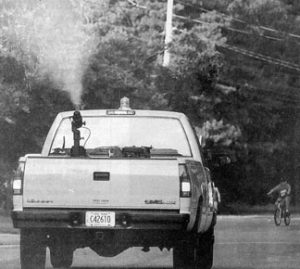 (Beyond Pesticides, September 10 2019) Does your community spray toxic pesticides for mosquitoes? In a well-intentioned but ill-informed attempt to prevent mosquito-borne illness such as West Nile virus, many communities spray insecticides (adulticides) designed to kill flying mosquitoes. If your community is one of these, then your public officials need to know that there is a better, more-effective, way to prevent mosquito breeding.
 (Beyond Pesticides, September 6, 2018) Red swamp crayfish have long been associated with Louisiana and Gulf Coast bayous, but the species has found new homes throughout the world over the last 70 years, and evidence is showing that their introduction may alter ecosystems in ways that increase mosquito populations and human disease risk. In late August, researchers at the University of California, Los Angeles and Pepperdine University published new evidence in the
 (Beyond Pesticides, August 31, 2018) Given the choice to forage on untreated or pesticide-contaminated food sources, bees will increasingly choose the pesticide, according to research published in


