





19
Jun
French Beekeepers Sue Bayer/Monsanto on Glyphosate in Honey; U.S. Court Allows Glyphosate Contamination of Honey Labeled “100% Pure”
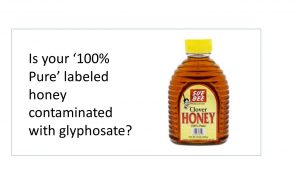 (Beyond Pesticides, June 19, 2018) Some 200 members of a French beekeeping cooperative in the northern Aisne region have sued Bayer — on the same day the giant chemical company’s acquisition of Monsanto was finalized — after discovering that their honey was contaminated with toxic glyphosate, a known endocrine disruptor and probable human carcinogen (according to the World Health Organization’s International Agency for Research on Cancer). Monsanto is the long-time manufacturer of Roundup, the popular glyphosate pesticide; Bayer now owns not only the company, but also, the liabilities that come with it, including the “Monsanto” name. Environmental activists had denounced the merger, which creates an agrichemical leviathan that promotes use of chemical herbicides and genetically engineered/modified (GE/GMO) seeds.
The beekeepers’ suit was filed in early June after Famille Michaud, a large French honey marketer, detected glyphosate contamination in three batches from one of the coop’s members — whose hives happen to border large fields of rapeseed, beets, and sunflowers. Glyphosate is commonly used in French agriculture; President Emmanuel Macron has vowed to ban its use by 2021.
Emmanuel Ludot, a lawyer for the cooperative, is looking for an outcome that includes mandated investigation of the extent of glyphosate contamination of honey, and of health consequences the pesticide represents for people. Mr. Ludot said, “It’s also a matter of knowing how widespread this might be. Famille Michaud tells me this isn’t an isolated case.” Familles Michaud president Vincent Michaud noted that “we regularly detect foreign substances, including glyphosate. Usually, beekeepers will say, ‘In that case I’ll sell the honey at a roadside stand or a market,’ where there’s no quality control. But this beekeeper had the courage to say, ‘I’m not going to be like everyone else, I’m going to file suit against Monsanto.’”
French beekeepers are not alone in pushing back on glyphosate contamination of honey. Stateside, several organizations and individuals have approached the issue with a different strategy. Rather than suing the manufacturer, in November 2016, Beyond Pesticides, along with the Organic Consumers Association (OCA), brought suit against Sioux Honey Association (Sue Bee Honey) in Superior Court in Washington, DC for deceptive and misleading labeling of its products. The suit, which followed revelations that Sue Bee honey products labeled “100% Pure” and “Natural” tested positive for glyphosate residue, claimed that Sioux Honey’s labeling and marketing practices violated the District of Columbia Consumer Protection Procedures Act. Plaintiffs’ argument was that consumers expect a product labeled “100% Pure” and “Natural” to contain only honey, and that contamination of the product makes that labeling deceptive and misleading.
The introduction to the filed complaint says, “Beekeepers are often the victims of, and have little recourse against, contamination of their hives caused by pesticide applications in the fields where bees forage. Given the failure of current law to protect beekeepers, retailers like Sioux Honey can and should use their market power to promote practices that protect beekeepers from contamination to ensure that consumers are provided products free of glyphosate and other pesticide residues. . . . Unless the paradigm of modern agriculture is shifted, however, synthetic chemicals will continue to contaminate everyday consumer products, and until that time, producers, distributors, and retailers of food products must be mindful of the fact that products containing such contaminants are not ‘natural’ or ‘pure,’ as a reasonable consumer would define the terms, and it is unlawful to label or advertise them as such.”
The intent of the suit was, broadly, to highlight the issue of pesticide contamination in the food supply. OCA director Ronnie Cummins said, “Regardless of how these products came to be contaminated, Sioux Honey has an obligation to . . . prevent the contamination, disclose the contamination, or at the very least, remove these deceptive labels.” Beyond Pesticides and OCA lost the case. In March 2017, Associate Judge William Jackson of the DC Superior Court granted Sioux Honey’s motion to dismiss, finding that there was no evidence consumers had been misled by Sioux’s labeling on the honey. He also found that the trace amounts of glyphosate in the honey “were not ingredients or additives because the chemical had been introduced into the products by bees carrying it back to the hive rather than something the company added during production.” The judge found that the court did not believe that consumers expect “pure” honey to be free from small amounts of glyphosate. Beyond Pesticides has not yet announced next steps in the case, but is determined, on all fronts, to highlight the fact that our food supply is being contaminated by glyphosate (and other pesticides).
In a similar case brought before a District Court in California — Susan Tran v. Sioux Honey Association, Cooperative — the U.S. Food and Drug Administration (FDA) responded to an order by Judge Josephine Staton, of the U.S. District Court for the Central District of California, asking FDA to determine whether and in what circumstances honey containing glyphosate may or may not be labeled “Pure” or “100% Pure.” The FDA declined to provide a determination, saying “FDA’s role is to ensure that pesticide chemical residues on or in food are lawful because they do not exceed the limits established by EPA or, if present on or in foods without a tolerance, EPA has established an exemption from the need for a tolerance. . . . Any food that bears or contains a pesticide chemical residue that is not within the limits of a tolerance established by EPA, or is not exempted from the need for a tolerance, is adulterated. . . . EPA has established tolerances for glyphosate on such crops as corn, soybean, oil seeds, grains, and some fruits and vegetables, EPA has not established any tolerances or exemptions for glyphosate in honey. FDA understands that EPA’s review of the safety of glyphosate is ongoing. FDA intends to consider the need for any appropriate actions with regard to glyphosate findings in honey in consultation with EPA.”
Essentially, FDA declined to issue a determination based on a lack of clarity about whether or not the presence of glyphosate residues in honey is lawful. Because EPA has issued neither a tolerance level, nor an exemption from such tolerance, for glyphosate, FDA asserts that its presence is in a sort “legal limbo” until, apparently, EPA decides to take up the matter. Beyond Pesticides contends that the lack of an established tolerance means that glyphosate should not be present in honey. Oddly, one of FDA’s points in its letter — “Any food that bears or contains a pesticide chemical residue that is not within the limits of a tolerance established by EPA, or is not exempted from the need for a tolerance, is adulterated” — would appear to support the contention of the plaintiffs.
The real and lasting solution is, of course, to disallow EPA registration of pesticides that will (or can) contaminate the food supply. Beyond Pesticides executive director Jay Feldman notes, “It is our hope that beekeepers in the U.S. will, as did those in France, join the effort to push back against the registration of pesticides that invade the environment and cause indiscriminate poisoning and contamination. Until that is achieved, it is misleading to label contaminated food — especially food without a tolerance — as ‘100% pure’ or ‘natural.’”
Beyond Pesticides works to educate the public and policy makers about the issues that attend pesticide use, and the multiplicity of impacts pesticides cause, or to which they contribute. See these Beyond Pesticides website pages, in particular: Center for Community Pesticide and Alternatives Information, Organic Agriculture, the Daily News Blog, and its journal, Pesticides and You. For more on pollinators and action steps you can take to protect them, go to Beyond Pesticides’ National Pollinator Week actions.
All unattributed positions and opinions in this piece are those of Beyond Pesticides.

 (Beyond Pesticides, June 14, 2018) With nearly 40% of Americans diagnosed as clinically obese, leading to health care costs estimated at over $200 billion, researchers are focusing on ways individuals can reduce their exposure to chemicals that contribute to weight gain regardless of diet or exercise. These chemicals, known as “obesogens,” include a range of consumer products, from pesticides to plastics and flame retardants. While diet and exercise remain critically important to fighting the ongoing obesity epidemic, obesogens may be working to increase appetite, fat storage, or make it more difficult for the body to shed fat once it is gained.
 (Beyond Pesticides, June 13, 2018) On June 6, 2018, the New York State Department of Environmental Conservation (NYSDEC) released its final policy for the disclosure of cleaning product ingredients under its Household Cleansing Product Information Disclosure Program. The program will require full disclosure of ingredients on product labels or manufacturer website for all products sold in the state, as well as the identification of chemicals of concern. NYSDEC states the program is intended to protect consumers from harmful chemicals in household products.
 (Beyond Pesticides, June 12, 2018) Two recent studies are contributing to the growing understanding that challenges basic toxicological precepts as inadequate to comprehensive assessments of impacts, particularly in the realm of human exposures to chemicals.
  (Beyond Pesticides, June 11, 2018) With
  (Beyond Pesticides, June 8, 2018) In the wake
 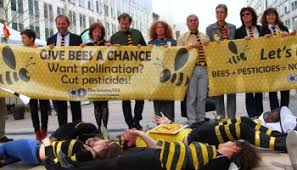 (Beyond Pesticides, June 7, 2018) Health Canada is proposing to phase out a number of uses of neonicotinoids in order to mitigate risks to pollinators. The agency has completed its review of clothianidin and thiamethoxam — two neonicotinoids that have been linked to pollinator decline and finds risks of concern for bees. However, these measures do not go as far as those recently made in the European Union, but further than label restrictions issued by the U.S. Environmental Protection Agency (EPA).
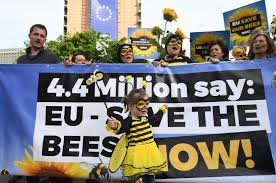 (Beyond Pesticides, June 6, 2018) By the close of 2018, three top neonicotinoid (neonic) pesticides, linked to the worldwide decline in bee populations, will be banned for outdoor use in the European Union (EU), based on the
  (Beyond Pesticides, June 5, 2018) After more than 100,000 Swiss citizens signed a petition calling for a ban on pesticides, Switzerland will soon have to vote on a complete ban on the use of synthetic pesticides. The ban would apply to farmers, industries, and imported goods, and advocates hope this measure would cause other EU nations to follow.
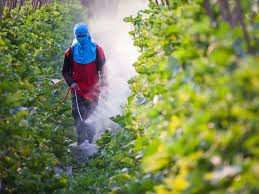 (Beyond Pesticides, June 1, 2018) States and civil society organizations launched new lawsuits in late May against the Pruitt Environmental Protection Agency (EPA) for its continued attack against farmworker health and safety. Two separate lawsuits, one filed by attorneys general in the states of California, Maryland, and New York, and another by health and justice advocates represented by Earthjustice and Farmworker Justice take aim at EPA’s decision to delay the implementation of training requirements designed to protect farmworkers and their families. This is the latest in a series of lawsuits which began when EPA announced
  (Beyond Pesticides, May 31, 2018) Deforestation in tropical regions helps spread malaria, concludes a
  (Beyond Pesticides, May 30, 2018) Six environmental groups have sued the Trump Administration for reversing a long standing interpretation of the Migratory Bird Treat Act (MBTA) that provides migratory bird protections from incidental killing or “taking” caused by industrial activities. The lawsuit,
  (Beyond Pesticides, May 29, 2018) The Farm Bill is beginning to move in the U.S. Senate Committee on Agriculture, Nutrition, and Forestry, and your voice is critically needed to help stop provisions that are harmful to health and the environment.
 (Beyond Pesticides, May 25, 2018) The results of a pilot study conducted by an international team of researchers finds that exposure to the
  (Beyond Pesticides, May 24, 2018) California’s Department of Pesticide Regulation (DPR) is falling short of protecting vulnerable communities in the state, especially low-income and communities of color. This, according to a new report by California Environmental Justice Alliance (CEJA), which assesses state agencies on eight environmental justice principles. The poor showing by DPR comes at the forefront of reports that the state’s pesticide use has increased, nearing record highs.
 (Beyond Pesticides, May 23, 2018) Earlier this month, the Connecticut state legislature voted to ban the use of residential pesticide misting systems. (These are devices that are typically placed outdoors and spray insecticides –mostly in an attempt to control mosquitoes.) This is the latest move from a state legislature that has also recently banned the use of
 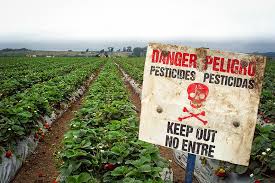 (Beyond Pesticides, May 22, 2018) A staggering
  (Beyond Pesticides, May 18, 2018) The U.S. Department of Agriculture (USDA) is putting an end to the process of
  (Beyond Pesticides, May 17, 2018) Among the many reports of the salutary effects of nature on human health and well-being comes


