





05
Apr
Local Democracy Wins Again as Pesticide Preemption Bill Is Voted Down in Maine
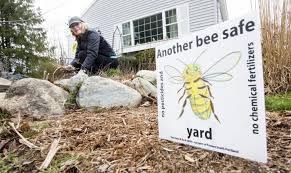 (Beyond Pesticides, April 5, 2018) An industry-backed attempt to enact pesticide preemption in the state of Maine is officially over after bill LD 1853 was voted down by a 9-2 margin earlier this week. The bill, introduced by state Senator Tom Saviello (R-Wilton), resembled a similar bill that failed in the same legislative committee last spring. With an ever increasing number of communities in Maine stepping up to protect their residents and unique local environment from pesticide contamination, the repeated introduction of preemption legislation means that health advocates and forward-thinking communities must continue to remain vigilant, and ready to fight to maintain their right to home rule.
LD 1853 would have taken away the rights of Maine municipalities to enact policies which wholly apply to private property. “I thought if there was a bill that would come back before us again it would be different,” said state Representative Richard Pickett (R-Dixfield) to the Portland Press Herald. “But we virtually had almost a duplicate bill and that troubled me.”
While last year’s failed legislation was modeled almost word for word from the notorious industry lobby group the American Legislative Exchange Council (ALEC), the changes in the new bill were superficial, and the intent remained the same. LD 1853 exempted licensed applicators in the state from municipal pesticide regulations. The impact of such a policy would stop an ordinance like the one recently passed in Portland, ME from applying to lawn care services like TruGreen, which use toxic pesticides on a regular basis as part of their business plan.
As reported by the Portland Press Herald, each iteration of this legislation has been promoted primarily by the state’s Governor, Paul LePage (R). In 2017, after the original ALEC-model bill failed, the Governor tried to insert preemption language as part of state budget negotiations. Governor LePage, who has a 53% disapproval rating, the 8th highest in the nation, is term limited and cannot seek reelection later this year.
While LePage may be on his way out, there is no indication that ALEC or the pesticide industry will stop attempts to institute state preemption in Maine, or any other state. The industry has attacked local laws in both Maryland and Hawaii, with an unfortunate degree of success. In both cases, despite no explicit preemption language codified into law in either state, industry argued that there is “implicit” preemption, whereby the state “occupies the field” when it comes to pesticide regulation. While options to appeal were limited in Hawaii, lawmakers in Montgomery County, Maryland, which passed a landmark ban on public and private cosmetic pesticide use, decided to appeal a Circuit Court ruling that overturned aspects of the ban that applied to private property.
The fact remains that, as ruled in the 1991 Supreme Court case Wisconsin Public Intervenor v. Mortier, FIFRA sets a floor, not a ceiling, which states and local communities can build additional laws upon in order to protect their unique local environment or their residents’ health. The court however also ruled that, while the federal government could not impose pesticide preemption, states would maintain the ability to do so. Thus, ALEC and the pesticide industry went state-by-state, working to pass preemption legislation throughout the 1990s, fearing the type of legislation passed by Maine local governments like Portland, South Portland, and Ogunquit.
Some communities, such as Oregon’s Lincoln County, have bucked state preemption laws despite the likelihood of a lawsuit. Late last year, a citizen-led ballot initiative banning aerial spraying passed by 61 votes. It was quickly followed by a lawsuit led by a local farmer who uses aerial pesticide sprays. Another locality, Fairfax, CA, passed a private property pesticide neighbor notification requirement in the early 2000s, and has kept the requirement in its Town code despite warning letters from the state. Last year, the communities of Oak Park and Evanston, IL both passed resolutions requesting the state of Illinois overturn pesticide preemption laws.
As the over a dozen localities in Maine that have pesticide ordinances that apply to private property show, when the state provides the opportunity, there is strong demand for local pesticide reform.
Tell us you’re ready to fight against the pesticide industry, and for a pesticide-free community by signing the pledge today. And for more information on why pesticide preemption is a threat to our local democratic process, see Beyond Pesticides’ State Preemption Law fact sheet.
All unattributed positions and opinions in this piece are those of Beyond Pesticides.
Source: Maine Legislature, Portland Press Herald

 (Beyond Pesticides, April 4, 2018) In late March, the Missouri Department of Agriculture hosted a public hearing to discuss a proposed emergency rule restricting the sale and use of the herbicides dicamba and 2,4-D – which are known for their ability to drift off-site and damage sensitive crops. The emergency rule was introduced to prevent off-label use of specific dicamba or 2,4-D products. Thus far, dicamba is responsible for damaging approximately 325,000 acres of soybeans in the state last year.
 (Beyond Pesticides, April 3, 2018) Humans’ unsustainable exploitation of natural resources, worldwide, has reached critical proportions, threatening the ability of an estimated 3.2 billion people to have food and water security, according to a new international study. The
  (Beyond Pesticides, April 2, 2018) The comment period closes Wednesday, April 4 at 11:59 pm for the Spring 2018 National Organic Standards Board (NOSB) Meeting.
 (Beyond Pesticides, March 30, 2018) While conventional farming practices rely primarily on new sources of synthetic nitrogen fertilizer to grow crops, organic agriculture conserves nitrogen by using recycled sources, as detailed by
  (Beyond Pesticides, March 29, 2018) Rising use of antibacterials like
  (Beyond Pesticides, March 28, 2018)
  (Beyond Pesticides, March 27, 2018) In a major win for farmworker and health groups, the U.S. District Court for the Northern District of California
  (Beyond Pesticides, March 26, 2018)
  (Beyond Pesticides, March 23, 2018) French scientists and ornithologists say parts of the country’s forests, streams, and bucolic landscapes could be completely devoid of birdsong this year, as the results of two recent studies show staggering declines in bird populations throughout the nation linked to the intensification of agricultural practices and pesticide use. The advent of so many significant wildlife declines at the same time –now recognized in birds, but also seen in
  (Beyond Pesticides, March 22, 2018) Last week Environmental Protection Agency (EPA) Administrator Scott Pruitt received a letter from twenty-eight U.S. Senators urging the preservation of rules that would protect farmworkers and disallow minors to handle highly toxic pesticides. At issue are two proposals from Administrator Scott Pruitt’s EPA that would roll back Agricultural Worker Protection Standards (AWPS) and the Certification of Pesticide Applicators (CPA) rules put in place during the Obama Administration. In their letter, the Senators stress the impact of any potential changes, noting “the lives of children and families across the country at stake.”
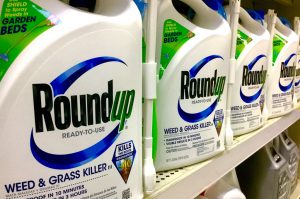 high levels of glyphosate in their bodies are more likely to have shorter pregnancies. Shorter pregnancies can lead to children with reduced learning and brain development. This is the first study to suggest that exposures to glyphosate can influence the long-term well-being of children.
 (Beyond Pesticides, March 20, 2018) Regulations that separate ingredients in
  (Beyond Pesticides, March 16, 2018) In a pattern of U.S. Department of Agriculture (USDA) actions that hurt the integrity of the organic label on food products, the agency has decided to withdraw final organic
  (Beyond Pesticides, March 15, 2018) On Tuesday, a group of 56 scientists studying the effects of neonicotinoids sent a letter to California’s Department of Pesticide Regulation (CDPR) highlighting the threat neonicotinoids pose to the health of California’s waterways. The scientists urge CDPR to take steps to reduce neonicotinoid contamination of the state’s streams and rivers. This comes as neonicotinoids were recently reported to be pervasive throughout the Great Lakes, and federal assessments confirm high risks to aquatic species.
 from last year’s numbers—a 15 percent decrease –according to figures from an official Mexican government count in the winter of 2017. These numbers underscore how at risk the iconic animal is, with a possible collapse of migration if populations are critically low.
 European Regulators Confirm Neonicotinoids Harm Bees, Increasing Likelihood of Continent-Wide Ban
 fatty acids than conventional and even organic milk, according to a study published by an international team of scientists in the journal
  predators, like bats and falcons on farms, can reduce pesticide use, increase on-farm productivity, and conserve wildlife, according to a literature review published by researchers at Michigan State University in the journal
  the world, do pose risks to honey bees and wild pollinators, according to a
  restrict the use of toxic pesticides, and move towards organic land management on all public property. By a unanimous vote of the City Council last week, Dover passed a resolution that requires the management of city land with “sound land management practices, and the use of least toxic compounds only when necessary, . . . thereby eliminating exposure to toxic pesticides on the part of our citizens and the environment.” The ordinance also instructs the city manager to “develop and execute a plan to transition the City to eliminate the use of synthetic fertilizers on City property.”


