





08
Jun
Bayer Ditches Monsanto Name in Merger
 (Beyond Pesticides, June 8, 2018) In the wake of U.S. Department of Justice (DOJ) approval of the buyout of Monsanto by Bayer, the new mega-corporation — now the world’s largest agrochemical and seed company — has announced that it will drop the “Monsanto” name, possibly as soon as late summer, when the acquisition is expected to be completed. Bayer first needs to sell off $9 billion in assets to German chemical giant BASF in compliance with a DOJ antitrust agreement that will permit the merger. The union of these two corporations, which joins Bayer’s pesticide business with Monsanto’s genetically engineered (GE) seed operations, faced vigorous opposition from health and environment advocates both in the U.S. and abroad.
Fortune magazine has pointed out that dropping a well-known name is unusual, but given that Monsanto is one of the world’s most-hated companies, perhaps the move is understandable. Ditching the “Monsanto” moniker is reportedly one aspect of a coming Bayer campaign to regain public trust and make efforts to engage with critics, according to Bayer spokespeople. Liam Condon, president of Bayer’s Crop Science Division, has said, “Just changing the name doesn’t do so much — we’ve got to explain to farmers and ultimately to consumers why this new company is important for farming, for agriculture and for food, and how that impacts consumers and the environment. Confirming the name Bayer is just one step. . . . Of course, there needs to be a lot more engagement.”
It is not yet clear what such “engagement” might mean, but Bayer is working hard at reconstructing perception of the company now that it has acquired Monsanto. Bayer CEO Werner Baumann added, “We will apply the same rigor to achieving our sustainability targets as we do to our financial targets.” He said, “We aim to deepen our dialogue with society. We will listen to our critics and work together where we find common ground. . . . Agriculture is too important to allow ideological differences to bring progress to a standstill. We have to talk to each other. We need to listen to each other. It’s the only way to build bridges.” When asked if Bayer will continue Monsanto’s underhanded business practices (see next paragraph), Mr. Baumann said, “The new entity will be managed ‘according to our standards,’ adding that ‘Bayer stands for transparency, reliability and a different style of debate.’”
Building the bridges that Mr. Baumann references will be a tall order. There is obviously great concern at Bayer about the baggage that comes with the Monsanto name and history. Monsanto has long been criticized for its products, including genetically engineered (GE) seeds and toxic pesticides. Among the latter was the devastating Agent Orange, used by the U.S. military during the Vietnam War and causing terrible harm to the land and people of Vietnam, and to U.S. military members who were in country during its use. The company has also drawn the ire of health, agriculture, and environment advocates for its campaigns to discredit researchers and anti-GE and environmental activists, and its bullying tactics toward farmers to “protect” what it has seen as its proprietary interests. It has drawn significant pushback on the health and environmental safety of its popular herbicides Roundup (which contains toxic glyphosate) and dicamba. Adding to its unsavory reputation is Monsanto’s manufacture, during its 177-year history, of such dubious products as the pesticide DDT (dichlorodiphenyltrichloroethane), PCBs (polychlorinated biphenyls), saccharin and aspartame, polystyrene, and nuclear weapons (1943–1945 for the Manhattan Project).
Yet, Bayer has its own issues, as Beyond Pesticides covered a couple of years ago. “Bayer’s parent company, Bayer AG, was part of the German chemical conglomerate I.G. Farben [IGF], which ran slave-labor factories during the Holocaust. . . . IGF also had a decisive share in a company that made Zyklon B gas, used to kill hundreds of thousands of Jews at Auschwitz [and] was intimately involved with the human experimental atrocities committed by Mengele at Auschwitz.” Bayer also manufactures neonicotinoid pesticides, which are disastrous for pollinators, and bisphenol-A, a chemical known to have damaging impacts on the human endocrine system.
Last year saw two other unions of giants: a Dow Chemical and DuPont (now DowDuPont) merger, and China’s National Chemical Company’s (ChemChina’s) buyout of Syngenta. These moves serve to concentrate further the control of global seed and pesticide markets; such concentration is always a worry and is why anti-trust laws exist, yet these corporations were able to navigate regulations to achieve this degree of consolidation. Together, DowDuPont, ChemChina, and the “new” Bayer would control nearly 70% of the world’s pesticide market, 80% of the U.S. corn-seed market, and 90% of the soybean market. The new Bayer alone is projected to control 29% of the world’s seeds and 24% of its pesticides. These are alarming statistics for people concerned about the impacts of chemical-intensive agriculture.
Advocates continue to be vocal in opposition to the merger and what they expect from the newly minted mega-company. One concern has been that Bayer would use the moment as an opportunity to introduce GE crops to Europe; the European Union has been circumspect about them, and some countries have outright banned certain varieties of GE seeds. In 2016, Bayer CEO Werner Baumann indicated that the new company would not introduce GE crops in Europe. At the time, he said, “We aren’t taking over Monsanto to establish GM [GE] plants in Europe. Some people think it might be easier for us than for Monsanto, given the reputation we enjoy, but that’s not our plan. If politics and society in Europe don’t want genetically modified seeds, then we accept that, even if we disagree on the substance.”
The reliability of such reassurance will unfold in the coming years, but there are other fronts for concern. Farmers worry about undue influence on them to expand their use of the new company’s products, corporate control of data on farmers’ practices, and ratcheted-up pressure for chemical-dependent farming. Advocates’ distress about the use of toxic pesticides is unlikely to diminish.
As The Guardian reports, “Adrian Bebb, a food and farming campaigner at Friends of the Earth Europe, said Bayer’s decision to ditch the Monsanto name would not alter the company’s legacy. ‘Bayer will become Monsanto in all but name unless it takes drastic measures to distance itself from the US chemical giant’s controversial past. . . . If it continues to peddle dangerous pesticides and unwanted GMOs then it will quickly find itself dealing with the same global resistance that Monsanto did. . . . This merger will create the world’s biggest and most powerful agribusiness corporation, which will try to force its genetically modified seeds and toxic pesticides into our food and countryside. . . . The coming together of these two is a marriage made in hell — bad for farmers, bad for consumers and bad for our countryside.”
Beyond Pesticides, in its Daily News Blog of September 19, 2016, noted that the Bayer–Monsanto merger — because the new entity will create a near-monopoly that will allow it to increase prices — may offer only short-term financial stability to the company, while increasing the wealth of top executives and raising food costs. “Observers say that in the long-term, the market will reveal that relying on the promotion of chemical-intensive agricultural practices is not a sustainable business practice. Chemical-intensive agriculture depends on chemical fertilizers and toxic pesticides that have been shown to reduce soil organic matter and decrease the diversity of soil biota. These chemical inputs contaminate waterways, leading to ‘dead zones’ where nothing is able to live or grow. Eventually, as chemical-intensive agriculture depletes organic matter in the soil and there is nothing left with which to grow food or sustain life, toxic chemical inputs will become obsolete. Sustainability advocates say that the only way that the agricultural industry can create a sustainable business model is to produce products that are compatible with organic agriculture.”
Good organic practices work to build the soil and maintain an ecological balance that makes chemical fertilizers and toxic synthetic pesticides obsolete. Claims that organic agriculture cannot feed the world because of lower yields are contested by scientific studies showing that organic yields are comparable to conventional yields and require significantly lower inputs. Organic agriculture advocates say that it is necessary not only to eliminate the use of toxic chemicals, but also, to ensure the long-term sustainability of food production.
The Bayer buyout of Monsanto also has organic farmers worried. Kristina Hubbard, director of advocacy and communications for the Organic Seed Alliance, notes that “the National Organic Program’s regulations on organic seeds generally dictate that growers must use organic seeds to grow their crops. But there is an exception granted for non-organic seed when ‘an equivalent organically produced variety is not commercially available.’ That exemption is important because currently the supply [of organic seeds] isn’t sufficient to meet the diverse and regional needs of all organic farmers. With continued consolidation in the seed industry, farmers that rely on those non-organic seed options may find themselves faced with even fewer options as the merged companies cut down on research and development.”
In the advocacy community, the name change surely will not keep people from monitoring the new Bayer, and exposing the harm that comes with toxic pesticides and near-monopolies on seeds. See Beyond Pesticides’ Organic Agriculture webpage.
Primary source: https://www.washingtonpost.com/news/wonk/wp/2018/06/04/why-monsanto-is-no-more/?utm_term=.23158e15b440

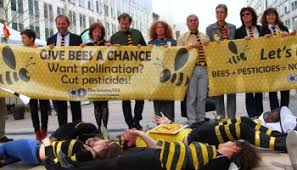 (Beyond Pesticides, June 7, 2018) Health Canada is proposing to phase out a number of uses of neonicotinoids in order to mitigate risks to pollinators. The agency has completed its review of clothianidin and thiamethoxam — two neonicotinoids that have been linked to pollinator decline and finds risks of concern for bees. However, these measures do not go as far as those recently made in the European Union, but further than label restrictions issued by the U.S. Environmental Protection Agency (EPA).
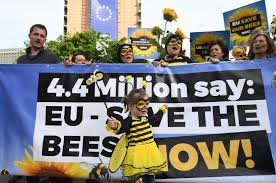 (Beyond Pesticides, June 6, 2018) By the close of 2018, three top neonicotinoid (neonic) pesticides, linked to the worldwide decline in bee populations, will be banned for outdoor use in the European Union (EU), based on the
 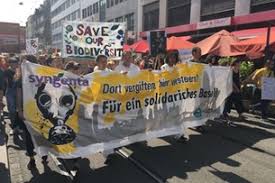 (Beyond Pesticides, June 5, 2018) After more than 100,000 Swiss citizens signed a petition calling for a ban on pesticides, Switzerland will soon have to vote on a complete ban on the use of synthetic pesticides. The ban would apply to farmers, industries, and imported goods, and advocates hope this measure would cause other EU nations to follow.
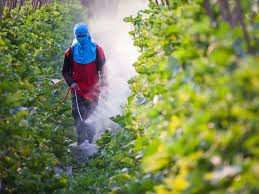 (Beyond Pesticides, June 1, 2018) States and civil society organizations launched new lawsuits in late May against the Pruitt Environmental Protection Agency (EPA) for its continued attack against farmworker health and safety. Two separate lawsuits, one filed by attorneys general in the states of California, Maryland, and New York, and another by health and justice advocates represented by Earthjustice and Farmworker Justice take aim at EPA’s decision to delay the implementation of training requirements designed to protect farmworkers and their families. This is the latest in a series of lawsuits which began when EPA announced
  (Beyond Pesticides, May 31, 2018) Deforestation in tropical regions helps spread malaria, concludes a
 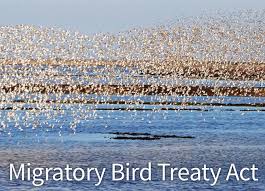 (Beyond Pesticides, May 30, 2018) Six environmental groups have sued the Trump Administration for reversing a long standing interpretation of the Migratory Bird Treat Act (MBTA) that provides migratory bird protections from incidental killing or “taking” caused by industrial activities. The lawsuit,
  (Beyond Pesticides, May 29, 2018) The Farm Bill is beginning to move in the U.S. Senate Committee on Agriculture, Nutrition, and Forestry, and your voice is critically needed to help stop provisions that are harmful to health and the environment.
 (Beyond Pesticides, May 25, 2018) The results of a pilot study conducted by an international team of researchers finds that exposure to the
  (Beyond Pesticides, May 24, 2018) California’s Department of Pesticide Regulation (DPR) is falling short of protecting vulnerable communities in the state, especially low-income and communities of color. This, according to a new report by California Environmental Justice Alliance (CEJA), which assesses state agencies on eight environmental justice principles. The poor showing by DPR comes at the forefront of reports that the state’s pesticide use has increased, nearing record highs.
 (Beyond Pesticides, May 23, 2018) Earlier this month, the Connecticut state legislature voted to ban the use of residential pesticide misting systems. (These are devices that are typically placed outdoors and spray insecticides –mostly in an attempt to control mosquitoes.) This is the latest move from a state legislature that has also recently banned the use of
 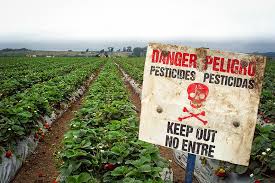 (Beyond Pesticides, May 22, 2018) A staggering
 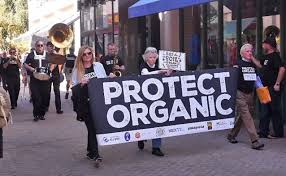 (Beyond Pesticides, May 18, 2018) The U.S. Department of Agriculture (USDA) is putting an end to the process of
  (Beyond Pesticides, May 17, 2018) Among the many reports of the salutary effects of nature on human health and well-being comes
  (Beyond Pesticides, May 16, 2018) Northern Harvest Sea Farms, an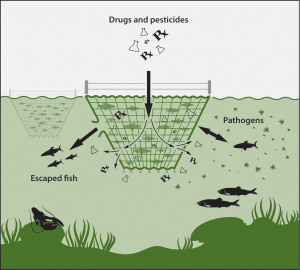
 (Beyond Pesticides, May 15, 2018) According to a new report from the Center for Biological Diversity (CBD), hundreds of thousands of pounds of pesticides are sprayed on lands that are designated as refuges for wildlife and protected under U.S. law. Approximately 490,000 pounds of pesticides have been sprayed on crops grown in national wildlife refuges in 2016 alone. Pesticide use in these sensitive areas poses risks to pollinators, aquatic organisms, migratory birds, and other wildlife on refuges that were created to protect them.
 (Beyond Pesticides, May 14, 2018)
 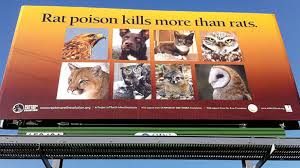 (Beyond Pesticides, May 10, 2018) Rodenticides like bromadiolone, used to kill vole populations on farms, act like “super-predators” that imperil ecosystem health, according to preliminary results
  (Beyond Pesticides, May 9, 2018) An insect’s gut microbiome plays an important role in conferring pesticide resistance, according to a new review published in the
  (Beyond Pesticides, May 8, 2018) U.S. Environmental Protection Agency Administrator Scott Pruitt’s controversial


