





25
Jun
Groups Defend Local Right to Protect Children and Community from Pesticides; Lawn Care Industry Attacks Local Authority
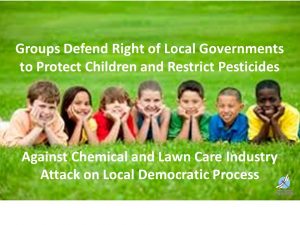 (Beyond Pesticides, June 25, 2018) Ten organizations filed an Amicus brief last week in support of a 2015 landmark Montgomery County, Maryland ordinance that restricts the use of toxic pesticides on public and private land within its jurisdiction. The law, intended to protect children, pets, wildlife, and the wider environment from the hazards of lawn and landscape pesticide use, is on appeal from a Circuit Court ruling in August 2017 which struck down aspects of the ordinance that apply to private property. The Montgomery County Council decided to appeal the Circuit Court ruling based on an outpouring of public support, and the advice of its legal team that the County has a reasonable chance of prevailing. The case will now be heard in front of the Court of Special Appeals of Maryland.
The plaintiffs in the case, which include the pesticide industry group Responsible Industry for a Sound Environment (RISE), local chemical lawn care companies, and a few individuals, allege that the local ordinance is preempted by state law, despite the fact that Maryland is one of seven states that has not explicitly taken away (or preempted) local authority to restrict pesticides more stringently than the state.
The law at issue, 52-14 (the Healthy Lawns Act), which restricts the cosmetic lawn care use of toxic pesticides on public and private land, protects over one million people, the largest number to be covered by any local jurisdiction to date. Passing the Montgomery County Council by a veto-proof majority 6-3, the bill allows time for transition, training, and a public education program over several years. In limiting the pesticides allowed to be used for turf management, the law defined acceptable materials as those permitted for use in organic production, or identified by the Environmental Protection Agency (EPA) as “minimum risk pesticides” under the Federal Insecticide, Fungicide and Rodenticide Act (FIFRA), Section 25(b).
“In the absence of federal and state pesticide restrictions that adequately protect children, pets, families, and the environment, and given the availability of sustainable organic practices to manage parks, playing fields and lawns, Montgomery County has exercised its fundamental right, under Maryland and federal law, to limit pesticide use on public and private property within its jurisdiction,” said Jay Feldman, executive director of Beyond Pesticides.
Although attempts to adopt “explicit” preemption were introduced in the Maryland legislature in the mid-1990s, industry was unsuccessful in gaining enough support, and the state lawmakers never passed legislation expressly preempting local pesticide legislation. Because of this, RISE and its affiliates argue that there is “implied” preemption on the part of the state that would prohibit a local jurisdiction like Montgomery County from taking action to protect its citizens. Although Circuit Court Judge Terrence McGann ruled in favor of the pesticide industry, advocates say the ruling ignores historical precedent set by Maryland counties in leading the way on health and environmental laws, including bans on plastic bags and coal-tar sealants. In the face of an EPA that is increasingly political in its decisions regarding public health, advocates say local laws like Montgomery County’s are more important than ever, and are hoping for a favorable ruling by the Court of Special Appeals.
The groups filing the Amicus include Beyond Pesticides, Center for Food Safety, Central Maryland Beekeepers Association, Chesapeake Physicians for Social Responsibility, Food and Water Watch, Maryland Pesticide Education Network, US PIRG, Maryland PIRG Foundation, Organic Consumers Association, and Safe Grow Montgomery.
Quotes from amici curiae
“It is not just a longstanding right, but a responsibility, of counties in the state to exercise their powers to the fullest to protect the health and wellbeing of their citizens. This lawsuit unfortunately seeks to strip Montgomery, and other counties in the state, of their critical role in the protection of public health,” said Chris Nidel, partner at Nidel & Nace, PLLC, which represents the amici.
“People’s concern about pesticides continues to increase, while their confidence in the EPA’s regulation continues to erode. Instead of fighting communities’ democratic right to local legislation, the landscaping and pesticide companies could grow their business in response to the high demand for pesticide-free services that don’t harm neighbors, children, pets, and pollinators. Thousands of county residents voiced support for the Healthy Lawns Act, and demand is growing outside the county as well,” said Alex Stavitsky-Zeineddin, Safe Grow Montgomery.
“Montgomery County did the right thing in passing this law. In children, there is increasing evidence that exposure to these pesticides is especially damaging, even at low, chronic levels,” said Tim Whitehouse, executive director of Chesapeake Physicians for Social Responsibility.
“Regular people in Montgomery County worked hard to pass a law that would protect their families’ health. But now a giant pesticide group, with big industry backing, is trying to come in and take that away. That’s not right. That doesn’t reflect the fighting spirit of Maryland. And that’s why we had to join in this brief,” said Kara Cook-Schultz, Toxics Director, Maryland PIRG Foundation.
“Montgomery County chose to protect its children, pollinators, all wildlife and Maryland’s waterways by its passage of an ordinance restricting the use of hazardous pesticides on public and private land. Safer landcare practices allow for a healthier, attractive county environment,” said Ruth Berlin, executive director of Maryland Pesticide Education Network.
“Like many communities around the country, the people of Montgomery County decided to exercise their right to protect their environment and loved ones from the harmful impacts of pesticides. Instead of respecting that right, the chemical industry is once again trying to trump the democratic process with their deep litigation pockets. CFS stands with the communities’ right to demand a cleaner environment,” said George Kimbrell, Legal Director at the Center for Food Safety.
All unattributed positions and opinions in this piece are those of Beyond Pesticides.
Contact:
Jay Feldman, 202-255-4296 [email protected]
Alex Stavitsky-Zeineddin, 202 360-7166 [email protected]

 (Beyond Pesticides, June 22, 2018) Mosquito misters pose a threat to human health. They also harm bees and other flying pollinators and are the least effective way to deal with biting mosquitoes. These devices are typically placed outdoors and spray insecticides –mostly in an attempt to control mosquitoes. In May, the Connecticut state legislature
  (Beyond Pesticides, June 21, 2018) In a letter sent by the Center for Biological Diversity (CBD), the U.S. Fish and Wildlife Service (FWS) is being urged to complete status reviews and listing proposals for 23 wildlife species in the Southeast that are at risk of extinction. Citing deep concerns about unprecedented assaults on the Endangered Species Act (ESA), the letter reiterates the critical need for FWS to provide timely protection to the most critically imperiled species.
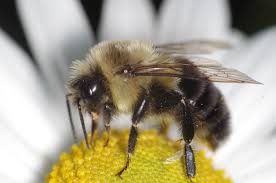 (Beyond Pesticides, June 20, 2018) Bumblebee queens that wake up from hibernation to a neonicotinoid-contaminated, monofloral landscape take longer to set up their nest and die-off at higher rates, according to new
  (Beyond Pesticides, June 19, 2018) Some 200 members of a
 (Beyond Pesticides, June 14, 2018) With nearly 40% of Americans diagnosed as clinically obese, leading to health care costs estimated at over $200 billion, researchers are focusing on ways individuals can reduce their exposure to chemicals that contribute to weight gain regardless of diet or exercise. These chemicals, known as “obesogens,” include a range of consumer products, from pesticides to plastics and flame retardants. While diet and exercise remain critically important to fighting the ongoing obesity epidemic, obesogens may be working to increase appetite, fat storage, or make it more difficult for the body to shed fat once it is gained.
 (Beyond Pesticides, June 13, 2018) On June 6, 2018, the New York State Department of Environmental Conservation (NYSDEC) released its final policy for the disclosure of cleaning product ingredients under its Household Cleansing Product Information Disclosure Program. The program will require full disclosure of ingredients on product labels or manufacturer website for all products sold in the state, as well as the identification of chemicals of concern. NYSDEC states the program is intended to protect consumers from harmful chemicals in household products.
 (Beyond Pesticides, June 11, 2018) With
  (Beyond Pesticides, June 8, 2018) In the wake
 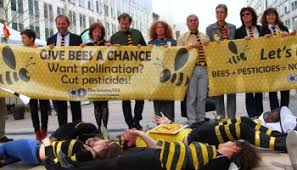 (Beyond Pesticides, June 7, 2018) Health Canada is proposing to phase out a number of uses of neonicotinoids in order to mitigate risks to pollinators. The agency has completed its review of clothianidin and thiamethoxam — two neonicotinoids that have been linked to pollinator decline and finds risks of concern for bees. However, these measures do not go as far as those recently made in the European Union, but further than label restrictions issued by the U.S. Environmental Protection Agency (EPA).
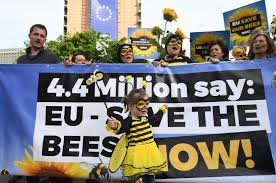 (Beyond Pesticides, June 6, 2018) By the close of 2018, three top neonicotinoid (neonic) pesticides, linked to the worldwide decline in bee populations, will be banned for outdoor use in the European Union (EU), based on the
 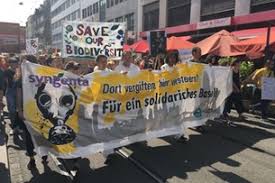 (Beyond Pesticides, June 5, 2018) After more than 100,000 Swiss citizens signed a petition calling for a ban on pesticides, Switzerland will soon have to vote on a complete ban on the use of synthetic pesticides. The ban would apply to farmers, industries, and imported goods, and advocates hope this measure would cause other EU nations to follow.
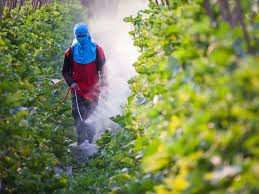 (Beyond Pesticides, June 1, 2018) States and civil society organizations launched new lawsuits in late May against the Pruitt Environmental Protection Agency (EPA) for its continued attack against farmworker health and safety. Two separate lawsuits, one filed by attorneys general in the states of California, Maryland, and New York, and another by health and justice advocates represented by Earthjustice and Farmworker Justice take aim at EPA’s decision to delay the implementation of training requirements designed to protect farmworkers and their families. This is the latest in a series of lawsuits which began when EPA announced
  (Beyond Pesticides, May 31, 2018) Deforestation in tropical regions helps spread malaria, concludes a
  (Beyond Pesticides, May 30, 2018) Six environmental groups have sued the Trump Administration for reversing a long standing interpretation of the Migratory Bird Treat Act (MBTA) that provides migratory bird protections from incidental killing or “taking” caused by industrial activities. The lawsuit,
  (Beyond Pesticides, May 29, 2018) The Farm Bill is beginning to move in the U.S. Senate Committee on Agriculture, Nutrition, and Forestry, and your voice is critically needed to help stop provisions that are harmful to health and the environment.
 (Beyond Pesticides, May 25, 2018) The results of a pilot study conducted by an international team of researchers finds that exposure to the
  (Beyond Pesticides, May 24, 2018) California’s Department of Pesticide Regulation (DPR) is falling short of protecting vulnerable communities in the state, especially low-income and communities of color. This, according to a new report by California Environmental Justice Alliance (CEJA), which assesses state agencies on eight environmental justice principles. The poor showing by DPR comes at the forefront of reports that the state’s pesticide use has increased, nearing record highs.


