 (Beyond Pesticides, April 6, 2018) Scott Pruitt, Administrator of the U.S. Environmental Protection Agency (EPA), is getting plenty of attention for what the public and some members of Congress see as his spendthrift and potentially corrupt behaviors since taking office in early 2017. Pundits and prognosticators who focus on the Washington, DC scene are speculating that this attention is not welcome by the White House, and wonder if Mr. Pruitt will soon be on the “wrong end of a Trump tweet.”
This may be refreshing news to environmental advocates, scientists, and public health experts, who have objected to the “changes” he’s brought to the agency, which frequently favor industry interests over science-based protection of the environment and public health. EPA’s moves to reduce enforcement, roll back protective regulations, and install industry-friendly personnel have been covered extensively by Beyond Pesticides; examples include: “Where Has All the EPA Enforcement Gone,” “The Threat to Scientific Integrity at EPA,” and regular posts in its Daily News Blog.
Administrator Pruitt calls his approach to EPA’s function “Back to Basics,” which he says includes a refocus on EPA’s “intended mission, a return of power to the states, and creation of an environment where jobs can grow.” The agency website sets out the “three Es” of the Back-to-Basics agenda: Environment: protecting the environment; Economy: sensible regulations that allow economic growth; and Engagement: engaging with state and local partners. The new agenda was announced in April 2017 at a coal mine in Sycamore, Pennsylvania — a telling gesture that betrays Pruitt’s actual allegiances: to the extractive, chemical, industrial, and transportation interests that are the chief sources of environmental degradation in the U.S.
Of course, neither the intent of its creators nor the mission of EPA identifies job creation and economic growth as aspects of the agency’s purview or goals. The agency’s mission reads: The United States Environmental Protection Agency is an agency of the federal government of the United States which was created for the purpose of protecting human health and the environment by writing and enforcing regulations based on laws passed by Congress.” The back-to-basics language that the Pruitt EPA has invented is a sleight of speech intended to skew public perception of what the EPA does, and thereby, create “cover” for its deconstruction of environmental protections.
One might presume that Mr. Pruitt, in promoting this agenda for the EPA, would also be promoting a culture of responsible spending by the agency. On the contrary, his spending has been far beyond basic, and has included routine travel by first-class airline flights or military jets and staying at high-end hotels. In June 2017, he and his aides racked up $90,000 in travel costs — which amount doesn’t include the cost of his 24/7 security detail. Mother Jones highlighted an example: “On Monday, June 5, accompanied by his personal security detail, Pruitt . . . raced to New York on a military jet, at a cost of $36,068.50, to catch a plane to Rome.”
Mr. Pruitt has also spent lavishly on contending with what he and his officials call “security threats.” To be sure, he has received four-to-five times as many threats as his predecessor, though the credibility of such threats is not clear — nor is it clear how flying first class keeps him any safer than flying coach. Politico notes that some of the threats have comprised only “threatening tweets and a menacing postcard.”
EPA initially claimed that Mr. Pruitt has a “blanket waiver” to upgrade from coach airline travel because of those “security threats.” That claim was investigated and discovered to be false; the General Services Administration bans “blanket waivers,” and mandates that government employees must request a waiver for each trip. After Politico publicly pointed this out, EPA walked back its claim.
Administrator Pruitt’s extreme concern about security has moved some observers to suggest a level of paranoia that is costing taxpayers a bundle. The spending on accommodations to perceived security threats includes $43,000 on installation of a soundproof phone booth in his office, and $9,000 to sweep his office for listening devices, and install biometric locks and “access control card readers.” His own employees are required to have an escort to come into his office, and are sometimes prohibited from taking notes at meetings. Pruitt’s team also guards his schedule carefully; some believe this is an effort to be unpredictable and so, less easily targeted. But it also makes it difficult for the Fourth Estate to cover the Administrator’s activities. Kate Yoder, writing for Grist, says, “The secretive schedule is a departure from the norm and shields him from some level of scrutiny. It’s unclear if Pruitt is more concerned about outside threats or keeping journalists and the public in the dark about what he’s up to.”
Mr. Pruitt has also insisted on an unprecedented, round-the-clock security detail to accompany him when he travels — including on vacation trips to the Rose Bowl and Disneyland, and on frequent trips back home to Oklahoma. Costs for this security detail — which always flies first class — have not been released, but CNN has indicated that they come in at approximately $2 million per year, not including travel, training, and equipment.
In early April, Rep. Elijah Cummings and Rep. Raja Krishnamoorthi called for hearings on whether the Trump administration has “adequate controls” to protect taxpayer money in light of recent “extravagant air travel” by cabinet members, calling out in particular Pruitt’s flight to Italy for a summit in 2017 that racked up $120,249, and naming it “questionable and expensive travel at the taxpayer expense.”
That Administrator Scott Pruitt came to his EPA position with a decidedly industry-friendly bent is old news. That history, which includes 14 lawsuits against the agency — 13 of which also included players from EPA-regulated industries — continues to be relevant context in which to consider the activity of Mr. Pruitt and his EPA. In what may be an example of a quid pro quo arrangement tied to a fossil fuel industry lobbyist, in the last week of March ABC News reported that Pruitt had secured an unusually advantageous deal for his living arrangement — in a high-price Capitol Hill neighborhood — during his first six months in DC.
The rental property belongs in part (via an LLC) to the wife of a lobbyist, J. Steven Hart, who not only has contributed to Mr. Pruitt’s political campaigns, but also, represents a liquefied natural gas company. Administrator Pruitt secured a deal to pay $50 a night for a single bedroom in a condo, and only for the nights he actually used it, expending a total of $6,100 over the six months. Mr. Pruitt’s daughter stayed in a second bedroom while interning at the White House and frequently used the condo kitchen, though that was not part of the deal. Bloomberg News reported that initially, Mr. Pruitt could not produce any documentation demonstrating a lease arrangement or any rental payments; the landlord ultimately provided EPA officials with such evidence.
EPA officials defended the arrangement; EPA official Justina Fugh indicated that Mr. Pruitt had “paid a fair price for what amounts to just a room. . . . So I don’t even think that the fact the house is owned by a person whose job is to be a lobbyist causes us concern.” Critics think otherwise: Craig Holman, government affairs lobbyist for Public Citizen, said in a news release, “This appears to be a gift from a lobbyist to the EPA administrator. . . . Scott Pruitt seems to be renting at well below market value — from a family member of a lobbyist who has business before the EPA.” Eric Schaeffer, director of the Environmental Integrity Project, said, “At the very least, it doesn’t look good for the administrator of EPA to have rented an apartment from the wife of an energy industry lobbyist who represents companies regulated by EPA.”
The editorial board of The Washington Post wrote, on April 2, that Ms. Fugh “described this as ‘a routine business transaction.’ Yet anyone who has suffered through finding a rental apartment in central Washington knows that reserving a bedroom for yourself at that price, paid for only sporadically and when you are in residence, without a year-long commitment, with a second bedroom available for family, is highly improbable if not impossible — without connections. . . . If Mr. Pruitt had paid fair rent on realistic terms, the connection would be merely concerning. In light of the cushy deal the administrator got, the arrangement is pure swamp.” The New York Times’s Paul Krugman went further in a March 30 Tweet, calling the deal a “de facto bribe.”
Media have covered this story as a potential conflict of interest scandal, noting that the arrangement creates at least the appearance of impropriety, if it does not constitute actual impropriety. Congressional Representative Carlos Curbelo has called Mr. Pruitt’s conduct “an embarrassment.” He and another Florida Republican, Rep. Ileana Ros-Lehtinen, have called for his resignation. Whether Administrator Pruitt’s spending or his special deal on housing would on their own merits win the attention of the White House is debatable. But the growing attention to Mr. Pruitt’s behavior is not likely welcome by the administration, which has in the past not appreciated being embarrassed by certain behaviors of its Cabinet members or appointees.
Source: https://grist.org/briefly/scott-pruitt-might-be-on-the-wrong-end-of-a-trump-tweet-soon-heres-why






 (Beyond Pesticides, April 10, 2018) Current strategies aimed at managing herbicide resistant weeds in agriculture are not effective and may exacerbate weed problems, according to research published earlier this year by scientists at University of Sheffield in the United Kingdom (UK). While the conventional wisdom in farming, promoted strongly by the chemical industry, is that resistance can be adequately managed by rotating the herbicides used, researchers did not find evidence to support this strategy. In an ode to Occam’s razor, a philosophical theory that hypotheses with the fewest assumptions may be the correct one, researchers found the best method to reduce weed resistance to herbicides was to reduce the overall use of herbicides.
 (Beyond Pesticides, April 9, 2018) A new international study finds that the unsustainable exploitation of natural resources worldwide has reached critical proportions, causing biodiversity loss and land degradation that threaten the food and water security of an estimated 3.2 billion people. Congress must act for the U.S. to become a signatory to the United Nations Convention on Biodiversity, joining the global community in working to develop and implement solutions to the biodiversity crisis.
 (Beyond Pesticides, April 5, 2018) An industry-backed attempt to enact pesticide preemption in the state of Maine is officially over after bill
  (Beyond Pesticides, April 4, 2018) In late March, the Missouri Department of Agriculture hosted a public hearing to discuss a proposed emergency rule restricting the sale and use of the herbicides dicamba and 2,4-D – which are known for their ability to drift off-site and damage sensitive crops. The emergency rule was introduced to prevent off-label use of specific dicamba or 2,4-D products. Thus far, dicamba is responsible for damaging approximately 325,000 acres of soybeans in the state last year.
 (Beyond Pesticides, April 3, 2018) Humans’ unsustainable exploitation of natural resources, worldwide, has reached critical proportions, threatening the ability of an estimated 3.2 billion people to have food and water security, according to a new international study. The
  (Beyond Pesticides, April 2, 2018) The comment period closes Wednesday, April 4 at 11:59 pm for the Spring 2018 National Organic Standards Board (NOSB) Meeting.
 (Beyond Pesticides, March 30, 2018) While conventional farming practices rely primarily on new sources of synthetic nitrogen fertilizer to grow crops, organic agriculture conserves nitrogen by using recycled sources, as detailed by
  (Beyond Pesticides, March 29, 2018) Rising use of antibacterials like
  (Beyond Pesticides, March 28, 2018)
  (Beyond Pesticides, March 27, 2018) In a major win for farmworker and health groups, the U.S. District Court for the Northern District of California
  (Beyond Pesticides, March 26, 2018)
  (Beyond Pesticides, March 23, 2018) French scientists and ornithologists say parts of the country’s forests, streams, and bucolic landscapes could be completely devoid of birdsong this year, as the results of two recent studies show staggering declines in bird populations throughout the nation linked to the intensification of agricultural practices and pesticide use. The advent of so many significant wildlife declines at the same time –now recognized in birds, but also seen in
  (Beyond Pesticides, March 22, 2018) Last week Environmental Protection Agency (EPA) Administrator Scott Pruitt received a letter from twenty-eight U.S. Senators urging the preservation of rules that would protect farmworkers and disallow minors to handle highly toxic pesticides. At issue are two proposals from Administrator Scott Pruitt’s EPA that would roll back Agricultural Worker Protection Standards (AWPS) and the Certification of Pesticide Applicators (CPA) rules put in place during the Obama Administration. In their letter, the Senators stress the impact of any potential changes, noting “the lives of children and families across the country at stake.”
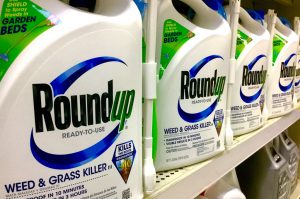 high levels of glyphosate in their bodies are more likely to have shorter pregnancies. Shorter pregnancies can lead to children with reduced learning and brain development. This is the first study to suggest that exposures to glyphosate can influence the long-term well-being of children.
 (Beyond Pesticides, March 16, 2018) In a pattern of U.S. Department of Agriculture (USDA) actions that hurt the integrity of the organic label on food products, the agency has decided to withdraw final organic
  (Beyond Pesticides, March 15, 2018) On Tuesday, a group of 56 scientists studying the effects of neonicotinoids sent a letter to California’s Department of Pesticide Regulation (CDPR) highlighting the threat neonicotinoids pose to the health of California’s waterways. The scientists urge CDPR to take steps to reduce neonicotinoid contamination of the state’s streams and rivers. This comes as neonicotinoids were recently reported to be pervasive throughout the Great Lakes, and federal assessments confirm high risks to aquatic species.
 from last year’s numbers—a 15 percent decrease –according to figures from an official Mexican government count in the winter of 2017. These numbers underscore how at risk the iconic animal is, with a possible collapse of migration if populations are critically low.
 European Regulators Confirm Neonicotinoids Harm Bees, Increasing Likelihood of Continent-Wide Ban
 fatty acids than conventional and even organic milk, according to a study published by an international team of scientists in the journal


